
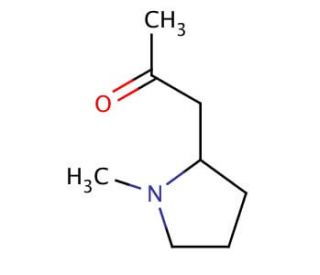

Hygrine (CAS 496-49-1)
See product citations (1)
QUICK LINKS
Hygrine, a derivative of pyrrolidine alkaloid, is a chemical compound that naturally occurs in the roots of specific plants, including the Hygrine officinalis shrub. This alkaloid has garnered attention for its biochemical and physiological effects, prompting investigations into its potential applications in laboratory research. Notably, hygrine exhibits properties such as anti-cancer, anti-inflammatory, and antioxidant effects in vitro. Moreover, hygrine has been used in the research of neurological disorders like epilepsy and Parkinson′s disease, as well as mental health conditions like depression and anxiety. The precise mechanism of action of hygrine remains incompletely understood. However, it is hypothesized that its effects on the central nervous system involve the modulation of specific neurotransmitters, including serotonin, norepinephrine, and dopamine.
Hygrine (CAS 496-49-1) References
- [Studies on tropane alkaloids. I. Paper chromatography of tropane alkaloids, hygrine, betaines, and xanthine]. | KIMURA, H. 1961. Yakugaku Zasshi. 81: 1699-702. PMID: 14456032
- Investigation of the Alkaloid Pattern of Datura innoxia Plants by Capillary Gas-Liquid-Chromatography-Mass Spectrometry. | Witte, L., et al. 1987. Planta Med. 53: 192-7. PMID: 17268993
- Hygrine and cuscohygrine as possible markers to distinguish coca chewing from cocaine abuse in workplace drug testing. | Rubio, C., et al. 2013. Forensic Sci Int. 227: 60-3. PMID: 23063180
- Alternative metabolic fates of hygrine in transformed root cultures of Nicandra physaloides. | Parr, AJ. 1992. Plant Cell Rep. 11: 270-3. PMID: 24203138
- Application of hygrine and cuscohygrine as possible markers to distinguish coca chewing from cocaine abuse on WDT and forensic cases. | Rubio, NC., et al. 2014. Forensic Sci Int. 243: 30-4. PMID: 24656326
- Possibilities for discrimination between chewing of coca leaves and abuse of cocaine by hair analysis including hygrine, cuscohygrine, cinnamoylcocaine and cocaine metabolite/cocaine ratios. | Rubio, NC., et al. 2015. Int J Legal Med. 129: 69-84. PMID: 25138383
- Unravelling the architecture and dynamics of tropane alkaloid biosynthesis pathways using metabolite correlation networks. | Nguyen, TK., et al. 2015. Phytochemistry. 116: 94-103. PMID: 25823585
- Biomimetic Approach toward the Total Synthesis of rac-2-(Acylmethylene)pyrrolidine Alkaloids. | Shih, YC., et al. 2015. J Org Chem. 80: 6669-78. PMID: 26029977
- Behaviour of hygrine and cuscohygrine in illicit cocaine production establishes their use as markers for chewing coca leaves in contrast with cocaine abuse. | Rubio, NC., et al. 2017. Drug Test Anal. 9: 323-326. PMID: 27004438
- Discrimination between chewing of coca leaves or drinking of coca tea and smoking of 'paco' (coca paste) by hair analysis. A preliminary study of possibilities and limitations. | Rubio, NC., et al. 2019. Forensic Sci Int. 297: 171-176. PMID: 30798102
- The role of hygrine in the biosynthesis of cuscohygrine and hyoscyamine. | O'Donovan, DG. and Keogh, MF. 1969. J Chem Soc Perkin 1. 2: 223-6. PMID: 5814732
- Biological activity of the alkaloids of Erythroxylum coca and Erythroxylum novogranatense. | Novák, M., et al. 1984. J Ethnopharmacol. 10: 261-74. PMID: 6379304
- Tropane alkaloids and toxicity of Convolvulus arvensis. | Todd, FG., et al. 1995. Phytochemistry. 39: 301-3. PMID: 7495531
- Determination and in-depth chromatographic analyses of alkaloids in South American and greenhouse-cultivated coca leaves. | Moore, JM., et al. 1994. J Chromatogr A. 659: 163-75. PMID: 8118557
Ordering Information
| Product Name | Catalog # | UNIT | Price | Qty | FAVORITES | |
Hygrine, 2.5 mg | sc-488263 | 2.5 mg | $520.00 | |||
Hygrine, 100 mg | sc-488263A | 100 mg | $18727.00 |