
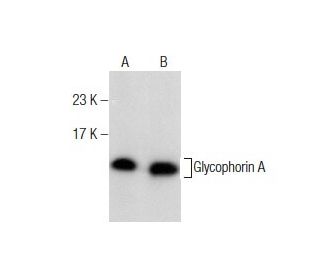


human erythrocyte lysate: sc-363759
- 500 µg protein in 200 µl SDS-PAGE Western blotting buffer
- Western blotting positive control
- recommended use is 50 µg (20 µl) per lane
- extracts should be stored at -20°C and repeated freezing and thawing should be minimized
- sample vial should be placed at 95° C for up to 5 minutes, once prior to use
- Not available in Germany.

QUICK LINKS
SEE ALSO...
Human erythrocyte lysate, commonly derived from red blood cells (erythrocytes), is a crucial substance utilized widely in biochemical and physiological research. Erythrocytes, known for their role in oxygen transport via hemoglobin, are collected typically through venipuncture. The cells are then lysed, a process that involves breaking the cell membranes to release their internal contents. This lysate is rich in hemoglobin and other intracellular molecules that are critical for studying the properties and functions of red blood cells. Researchers use human erythrocyte lysate to investigate the biochemistry of hemoglobin, including its oxygen-carrying capacity and its behavior under various physiological conditions. Additionally, the lysate is instrumental in examining the metabolic pathways of erythrocytes, such as glycolysis and the pentose phosphate pathway, which are vital for cell energy and integrity. This extract also provides insights into the oxidative stress responses of red blood cells, including how they manage reactive oxygen species and protect themselves from damage, which is essential for understanding cellular aging and resilience. Through these applications, human erythrocyte lysate serves as an invaluable tool in advancing our knowledge of cellular metabolism, physiology, and the dynamics of blood-related processes.
human erythrocyte lysate References:
- Interaction of Bartonella bacilliformis with human erythrocyte membrane proteins. | Buckles, EL. and McGinnis Hill, E. 2000. Microb Pathog. 29: 165-74. PMID: 10968948
- High-performance liquid chromatography/fluorescence detection of S-methylglutathione formed by glutathione-S-transferase T1 in vitro. | Mυller, M., et al. 2001. Arch Toxicol. 74: 760-7. PMID: 11305778
- Inhibition of erythrocyte phosphoribosyltransferases (APRT and HPRT) by Pb2+: a potential mechanism of lead toxicity. | Baranowska-Bosiacka, I., et al. 2009. Toxicology. 259: 77-83. PMID: 19428946
- Absence of erythrocyte arginase protein in Japanese patients with hyperargininemia. | Hayakawa, C., et al. 1991. Eur J Pediatr. 150: 800-3. PMID: 1959545
- Effect of thiol drugs on tert-butyl hydroperoxide induced luminol chemiluminescence in human erythrocytes, erythrocyte lysate, and erythrocyte membranes. | Sajewicz, W. 2010. Chem Biol Interact. 186: 144-51. PMID: 20430017
- Coisolation of glutathione peroxidase, catalase and superoxide dismutase from human erythrocytes. | Stepanik, TM. and Ewing, DD. 1990. J Biochem Biophys Methods. 20: 157-69. PMID: 2313035
- Comparative study on thiol drugs′ effect on tert-butyl hydroperoxide induced luminol chemiluminescence in human erythrocyte lysate and hemoglobin oxidation. | Sajewicz, W., et al. 2015. Toxicol In Vitro. 29: 148-54. PMID: 25308193
- Preparative free solution isoelectric focusing of human erythrocyte uroporphyrinogen I synthase in an ampholyte pH gradient. | Veser, J. 1989. Anal Biochem. 182: 217-21. PMID: 2610337
- Comparison of 6-mercaptopurine with 6-thioguanine for the analysis of thiopurine S-methyltransferase activity in human erythrocyte by LC-MS/MS. | Mei, S., et al. 2017. Biomed Chromatogr. 31: PMID: 28212467
- Enzymatic kinetics regarding reversible metabolism of CS-0777, a sphingosine 1-phosphate receptor modulator, via phosphorylation and dephosphorylation in humans. | Inaba, SI., et al. 2018. Xenobiotica. 48: 258-268. PMID: 28287856
- Metabolism of 9-(1,3-dihydroxy-2-propoxymethyl)guanine, a new anti-herpes virus compound, in herpes simplex virus-infected cells. | Cheng, YC., et al. 1983. J Biol Chem. 258: 12460-4. PMID: 6313660
- The physicochemical properties of erythrocyte derived activity which enhances murine bone marrow colony growth in agar culture. | Bertoncello, I. and Bradley, TR. 1977. Aust J Exp Biol Med Sci. 55: 281-92. PMID: 911280
- Relative contribution of human erythrocyte aldehyde dehydrogenase to the systemic detoxification of the oxazaphosphorines. | Dockham, PA., et al. 1997. Drug Metab Dispos. 25: 1436-41. PMID: 9394035
Ordering Information
| Product Name | Catalog # | UNIT | Price | Qty | FAVORITES | |
Human Erythrocyte Lysate | sc-363759 | 500 µg/200 µl | $120.00 |