
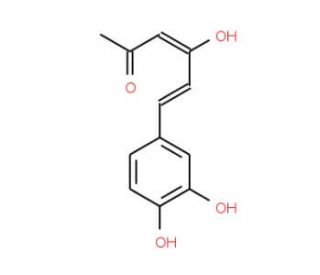

Molecular structure of Hispolon, CAS Number: 173933-40-9
Hispolon (CAS 173933-40-9)
See product citations (11)
Alternate Names:
(3Z,5E)-6-(3,4-dihydroxyphenyl)-4-hydroxy-hexa-3,5-dien-2-one
Application:
Hispolon is a polyphenolic compound that induces ROS-mediated apoptosis
CAS Number:
173933-40-9
Purity:
≥98%
Molecular Weight:
220.20
Molecular Formula:
C12H12O4
For Research Use Only. Not Intended for Diagnostic or Therapeutic Use.
* Refer to Certificate of Analysis for lot specific data.
QUICK LINKS
Ordering Information
Product Citations
Description
Technical Information
Safety Information
SDS & Certificate of Analysis
Hispolon is a polyphenolic compound that induces ROS-mediated apoptosis. Has antiviral activity. Hispolon is derived from the fruiting body of the mushroom Phellinus linteus. It exhibits antioxidant properties through its ability to scavenge free radicals and alleviate oxidative stress.
Hispolon (CAS 173933-40-9) References
- The apoptosis effect of hispolon from Phellinus linteus (Berkeley & Curtis) Teng on human epidermoid KB cells. | Chen, W., et al. 2006. J Ethnopharmacol. 105: 280-5. PMID: 16563677
- Hispolon induces apoptosis in human gastric cancer cells through a ROS-mediated mitochondrial pathway. | Chen, W., et al. 2008. Free Radic Biol Med. 45: 60-72. PMID: 18423410
- Analgesic effects and the mechanisms of anti-inflammation of hispolon in mice. | Chang, HY., et al. 2011. Evid Based Complement Alternat Med. 2011: 478246. PMID: 19349477
- Hispolon from Phellinus linteus has antiproliferative effects via MDM2-recruited ERK1/2 activity in breast and bladder cancer cells. | Lu, TL., et al. 2009. Food Chem Toxicol. 47: 2013-21. PMID: 19477214
- Hispolon induces apoptosis and cell cycle arrest of human hepatocellular carcinoma Hep3B cells by modulating ERK phosphorylation. | Huang, GJ., et al. 2011. J Agric Food Chem. 59: 7104-13. PMID: 21630638
- Hispolon from Phellinus linteus induces G0/G1 cell cycle arrest and apoptosis in NB4 human leukaemia cells. | Chen, YC., et al. 2013. Am J Chin Med. 41: 1439-57. PMID: 24228611
- The anticancer effects of hispolon on lung cancer cells. | Wu, Q., et al. 2014. Biochem Biophys Res Commun. 453: 385-91. PMID: 25268766
- Hispolon suppresses migration and invasion of human nasopharyngeal carcinoma cells by inhibiting the urokinase-plasminogen activator through modulation of the Akt signaling pathway. | Ho, HY., et al. 2017. Environ Toxicol. 32: 645-655. PMID: 27037602
- Effects of hispolon on glioblastoma cell growth. | Arcella, A., et al. 2017. Environ Toxicol. 32: 2113-2123. PMID: 28618133
- Hispolon suppresses metastasis via autophagic degradation of cathepsin S in cervical cancer cells. | Hsin, MC., et al. 2017. Cell Death Dis. 8: e3089. PMID: 28981104
- Elucidating the anti-melanoma effect and mechanisms of Hispolon. | Al Saqr, A., et al. 2020. Life Sci. 256: 117702. PMID: 32387411
- Hispolon: A natural polyphenol and emerging cancer killer by multiple cellular signaling pathways. | Sarfraz, A., et al. 2020. Environ Res. 190: 110017. PMID: 32768475
- Hispolon induces apoptosis in oral squamous cell carcinoma cells through JNK/HO-1 pathway activation. | Yang, WE., et al. 2023. J Cell Mol Med.. PMID: 36967712
Ordering Information
| Product Name | Catalog # | UNIT | Price | Qty | FAVORITES | |
Hispolon, 5 mg | sc-221726 | 5 mg | $124.00 | |||
Hispolon, 25 mg | sc-221726A | 25 mg | $459.00 | |||
Hispolon, 500 mg | sc-221726B | 500 mg | $7085.00 | |||
Hispolon, 1 g | sc-221726C | 1 g | $12495.00 |