
Date published: 2026-4-24

1-800-457-3801

SCBT Portrait Logo
Seach Input

Hip1r Antibody (44): sc-135937

5.0(3)
Write a reviewAsk a question

Datasheets
  • Hip1r Antibody (44) is a mouse monoclonal IgG1 Hip1r antibody, cited in 1 publications, provided at 50 µg/0.5 ml
  • raised against amino acids 560-772 of Hip1r of mouse origin
  • recommended for detection of HIP12 of human origin, Hip1r of mouse origin and the corresponding rat and canine homologs by WB, IP and IF
  • At present, we have not yet completed the identification of the preferred secondary detection reagent(s) for Hip1r Antibody (44). This work is in progress.
Gene Editing Promo Banner

QUICK LINKS

SEE ALSO...

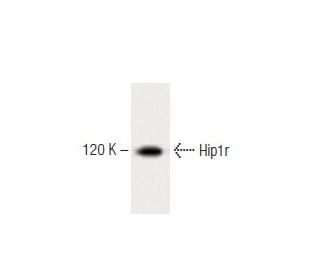
Hip1r Antibody (44) is a mouse monoclonal IgG1 antibody that detects Hip1r protein of mouse, rat, human, and canine origin by western blotting (WB), immunoprecipitation (IP), and immunofluorescence (IF). Anti-Hip1r antibody (44) is available as a non-conjugated format, providing researchers with a reliable tool for studying this critical protein. Hip1r monoclonal antibody (44) enables investigation of Hip1r′s vital role in vesicular trafficking, functioning as a component of clathrin-coated pits and vesicles, which are essential for the internalization of membrane proteins and lipids. This process is crucial for maintaining cellular homeostasis and regulating signaling pathways, as cells respond to external stimuli by modulating membrane composition. Hip1r (44) antibody helps reveal Hip1r′s interaction with the actin cytoskeleton, highlighting its importance in linking endocytic processes to cytoskeletal dynamics, thereby influencing cell shape and motility. Studies involving double knockout mice exhibit severe developmental defects and early mortality, indicating that Hip1r, along with its homolog Hip1, plays compensatory roles in cellular functions. Anti-Hip1r antibody (44) enables researchers to gain deeper insights into the mechanisms underlying vesicular trafficking and its implications in various diseases, including neurodegenerative disorders.

For Research Use Only. Not Intended for Diagnostic or Therapeutic Use.

Alexa Fluor® is a trademark of Molecular Probes Inc., OR., USA

LI-COR® and Odyssey® are registered trademarks of LI-COR Biosciences

Hip1r Antibody (44) References:

  1. The actin-binding protein Hip1R associates with clathrin during early stages of endocytosis and promotes clathrin assembly in vitro.  |  Engqvist-Goldstein, AE., et al. 2001. J Cell Biol. 154: 1209-23. PMID: 11564758
  2. HIP1 and HIP1r stabilize receptor tyrosine kinases and bind 3-phosphoinositides via epsin N-terminal homology domains.  |  Hyun, TS., et al. 2004. J Biol Chem. 279: 14294-306. PMID: 14732715
  3. Hip1-related mutant mice grow and develop normally but have accelerated spinal abnormalities and dwarfism in the absence of HIP1.  |  Hyun, TS., et al. 2004. Mol Cell Biol. 24: 4329-40. PMID: 15121852
  4. Structural definition of the F-actin-binding THATCH domain from HIP1R.  |  Brett, TJ., et al. 2006. Nat Struct Mol Biol. 13: 121-30. PMID: 16415883
  5. Degenerative phenotypes caused by the combined deficiency of murine HIP1 and HIP1r are rescued by human HIP1.  |  Bradley, SV., et al. 2007. Hum Mol Genet. 16: 1279-92. PMID: 17452370
  6. Actin binding by Hip1 (huntingtin-interacting protein 1) and Hip1R (Hip1-related protein) is regulated by clathrin light chain.  |  Wilbur, JD., et al. 2008. J Biol Chem. 283: 32870-9. PMID: 18790740
  7. Cloning, expression analysis, and chromosomal localization of HIP1R, an isolog of huntingtin interacting protein (HIP1).  |  Seki, N., et al. 1998. J Hum Genet. 43: 268-71. PMID: 9852681

Ordering Information

Product NameCatalog #UNITPriceQtyFAVORITES

Hip1r Antibody (44)

sc-135937
50 µg/0.5 ml
$322.00

I am using Hip1r (44): sc-135937 for immunofluorescence, what dilution of this antibody should I use?

Asked by: Professor Griffin
Thank you for your question. We recommend a starting dilution of 1:50. However, optimal antibody concentration should be determined by titration. Please find our full immunofluorescence protocol here: https://www.scbt.com/scbt/resources/protocols/immunofluorescence-cell-staining
Answered by: Technical Support
Date published: 2017-03-24
  • y_2026, m_4, d_23, h_7CST
  • bvseo_bulk, prod_bvqa, vn_bulk_3.0.43
  • cp_1, bvpage1
  • co_hasquestionsanswers, tq_1
  • loc_en_US, sid_135937, prod, sort_[SortEntry(order=LAST_APPROVED_ANSWER_SUBMISSION_TIME, direction=DESCENDING)]
  • clientName_scbt
  • bvseo_sdk, java_sdk, bvseo-4.0.0
  • CLOUD, getContent, 120ms
  • QUESTIONS, PRODUCT
Rated 5 out of 5 by from Good choice for Western BlotThis antibody has been used for immunoprecipitation and western blot in published research. -SCBT QC
Date published: 2023-09-14
Rated 5 out of 5 by from Exceptional immunofluorescence cytoplasmicExceptional immunofluorescence cytoplasmic staining in BC3H1 cells. -SCBT QC
Date published: 2015-04-18
  • y_2026, m_4, d_23, h_7
  • bvseo_bulk, prod_bvrr, vn_bulk_3.0.43
  • cp_1, bvpage1
  • co_hasreviews, tv_1, tr_2
  • loc_en_US, sid_135937, prod, sort_[SortEntry(order=SUBMISSION_TIME, direction=DESCENDING)]
  • clientName_scbt
  • bvseo_sdk, java_sdk, bvseo-4.0.0
  • CLOUD, getReviews, 15ms
  • REVIEWS, PRODUCT
Hip1r Antibody (44) is rated 5.0 out of 5 by 3.
  • y_2026, m_4, d_23, h_7
  • bvseo_bulk, prod_bvrr, vn_bulk_3.0.43
  • cp_1, bvpage1
  • co_hasreviews, tv_1, tr_2
  • loc_en_US, sid_135937, prod, sort_[SortEntry(order=SUBMISSION_TIME, direction=DESCENDING)]
  • clientName_scbt
  • bvseo_sdk, java_sdk, bvseo-4.0.0
  • CLOUD, getAggregateRating, 109ms
  • REVIEWS, PRODUCT
