
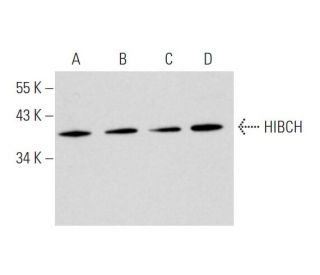


HIBCH Antibody (E-11): sc-515355
- HIBCH Antibody (E-11) is a mouse monoclonal IgM κ HIBCH antibody, cited in 3 publications, provided at 200 µg/ml
- specific for an epitope mapping between amino acids 272-296 within an internal region of HIBCH of human origin
- recommended for detection of HIBCH of mouse, rat and human origin by WB, IP, IF, IHC(P) and ELISA
- m-IgGκ BP-HRP is the preferred secondary detection reagent for HIBCH Antibody (E-11) for WB and IHC(P) applications. This reagent is now offered in a bundle with HIBCH Antibody (E-11) (see ordering information below). For additional m-IgGκ BP conjugates see our complete list of Mouse IgG Binding Proteins.

QUICK LINKS
SEE ALSO...
HIBCH Antibody (E-11) is a mouse monoclonal IgM antibody that detects HIBCH protein of mouse, rat, and human origin by western blotting (WB), immunoprecipitation (IP), immunofluorescence (IF), and enzyme-linked immunosorbent assay (ELISA). Anti-HIBCH antibody (E-11) is available as the non-conjugated form. HIBCH, also known as 3-hydroxyisobutyryl-CoA hydrolase, consists of 386 amino acids and belongs to the enoyl-CoA hydratase/isomerase family. HIBCH is primarily localized in the mitochondria, where HIBCH plays a crucial role in the metabolism of branched-chain fatty acids and certain amino acids. This localization is significant because mitochondrial dysfunction can lead to various metabolic disorders, including those associated with energy production and fatty acid metabolism. HIBCH is highly expressed in the liver and kidney, with lower expression levels in the heart, muscle, and brain. HIBCH hydrolyzes HIBYL-CoA, a saline catabolite, and beta-hydroxypropionyl-CoA, which is an intermediate in the minor pathway of propionate metabolism. The gene encoding HIBCH is located on human chromosome 2q32.2 and exists in two alternatively spliced isoforms. Defects in this gene can lead to HIBCH deficiency (HIBCHD), also known as deficiency of beta-hydroxyisobutyryl CoA deacylase or methacrylic aciduria, which is characterized by the accumulation of methacrylyl-CoA, a highly reactive compound that can interact with free sulfhydryl groups. Phenotypic symptoms of HIBCHD include early deterioration of neurological function, delayed motor skill development, and hypotonia, highlighting the importance of HIBCH in maintaining metabolic balance and neurological health.
Alexa Fluor® is a trademark of Molecular Probes Inc., OR., USA
LI-COR® and Odyssey® are registered trademarks of LI-COR Biosciences
HIBCH Antibody (E-11) References:
- Generation and annotation of the DNA sequences of human chromosomes 2 and 4. | Hillier, LW., et al. 2005. Nature. 434: 724-31. PMID: 15815621
- Mutations in the gene encoding 3-hydroxyisobutyryl-CoA hydrolase results in progressive infantile neurodegeneration. | Loupatty, FJ., et al. 2007. Am J Hum Genet. 80: 195-9. PMID: 17160907
- Lysine acetylation targets protein complexes and co-regulates major cellular functions. | Choudhary, C., et al. 2009. Science. 325: 834-40. PMID: 19608861
- Hemizygous deletion of COL3A1, COL5A2, and MSTN causes a complex phenotype with aortic dissection: a lesson for and from true haploinsufficiency. | Meienberg, J., et al. 2010. Eur J Hum Genet. 18: 1315-21. PMID: 20648054
- beta-hydroxyisobutyryl coenzyme A deacylase deficiency: a defect in valine metabolism associated with physical malformations. | Brown, GK., et al. 1982. Pediatrics. 70: 532-8. PMID: 7122152
- Primary structure and tissue-specific expression of human beta-hydroxyisobutyryl-coenzyme A hydrolase. | Hawes, JW., et al. 1996. J Biol Chem. 271: 26430-4. PMID: 8824301
Ordering Information
| Product Name | Catalog # | UNIT | Price | Qty | FAVORITES | |
HIBCH Antibody (E-11) | sc-515355 | 200 µg/ml | $322.00 | |||
HIBCH Antibody (E-11): m-IgGκ BP-HRP Bundle | sc-552728 | 200 µg Ab; 40 µg BP | $361.00 | |||
HIBCH (E-11) Neutralizing Peptide | sc-515355 P | 100 µg/0.5 ml | $69.00 |