
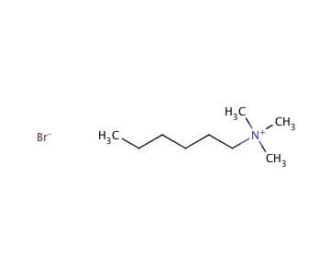

Molecular structure of Hexyltrimethylammonium bromide, CAS Number: 2650-53-5
Hexyltrimethylammonium bromide (CAS 2650-53-5)
Application:
Hexyltrimethylammonium bromide is a useful phase transfer catalyst
CAS Number:
2650-53-5
Molecular Weight:
224.18
Molecular Formula:
C9H22BrN
For Research Use Only. Not Intended for Diagnostic or Therapeutic Use.
* Refer to Certificate of Analysis for lot specific data.
QUICK LINKS
Ordering Information
Description
Technical Information
Safety Information
SDS & Certificate of Analysis
Hexyltrimethylammonium bromide is a cationic surfactant renowned for its versatile applications in scientific research and laboratory experiments. This quaternary ammonium salt consists of a hexyl group bonded to a trimethylammonium cation. Its distinct properties, such as the capability to solubilize and stabilize proteins and its antimicrobial effects, have made it indispensable in various fields, including biochemistry, physiology, and pharmacology. Its mechanism involves the creation of a hydrophobic layer on the surface of proteins and DNA molecules, effectively preventing their interaction with other substances in the solution.
Hexyltrimethylammonium bromide (CAS 2650-53-5) References
- Thermodynamics of Association of Structurally Related Amphiphilic Penicillins. | Taboada, P., et al. 2000. J Colloid Interface Sci. 221: 242-245. PMID: 10631026
- Fabrication of ultrafine conducting polymer and graphite nanoparticles. | Jang, J., et al. 2002. Angew Chem Int Ed Engl. 41: 4016-9. PMID: 12412067
- Observation of electrochemical single-electron-transfer events of gold nanoparticles in aqueous solution in the presence of both ammonium and sulfonate surface-active agents. | Nakai, M., et al. 2008. Angew Chem Int Ed Engl. 47: 6699-702. PMID: 18646032
- Colorimetric and fluorometric detection of cationic surfactants based on conjugated polydiacetylene supramolecules. | Chen, X., et al. 2009. Chem Commun (Camb). 3434-6. PMID: 19503895
- Large- and small-nanopore silica prepared with a short-chain cationic fluorinated surfactant. | Tan, B., et al. 2005. Nanotechnology. 16: S502-7. PMID: 21727471
- Nonaromatic hydrotropic cationic ammonium salts as a rheology modifier for an anionic/zwitterionic surfactant mixture. | Singh, K., et al. 2014. Langmuir. 30: 3673-80. PMID: 24625067
- Communication: Coordination structure of bromide ions associated with hexyltrimethylammonium cations at liquid/liquid interfaces under potentiostatic control as studied by total-reflection X-ray absorption fine structure. | Nagatani, H., et al. 2014. J Chem Phys. 140: 101101. PMID: 24628145
- Phosphonated Pillar[5]arene-Valved Mesoporous Silica Drug Delivery Systems. | Huang, X., et al. 2017. ACS Appl Mater Interfaces. 9: 19638-19645. PMID: 28530792
- Synthesis and Characterization of Dental Nanocomposite Resins Filled with Different Clay Nanoparticles. | Nikolaidis, AK., et al. 2019. Polymers (Basel). 11: PMID: 31013632
- Quantification of the actions of agonists that simultaneously act on a particular type of receptor and have separate functional interactant properties. | Goodall, J., et al. 1986. Br J Pharmacol. 88: 639-44. PMID: 3742152
- Gas chromatographic evaluation of the influence of oxotremorine upon the regional distribution of acetylcholine in rat brain. | Campbell, LB. and Jenden, DJ. 1970. J Neurochem. 17: 1697-9. PMID: 5492991
- Estimation of choline esters in brain by a new gas chromatographic procedure. | Hanin, I. and Jenden, DJ. 1969. Biochem Pharmacol. 18: 837-45. PMID: 5788521
- A Study of the Aggregation Behavior of Hexyltrimethylammonium Bromide in Aqueous Solution. | Mosquera, V., et al. 1998. J Colloid Interface Sci. 206: 66-76. PMID: 9761629
Ordering Information
| Product Name | Catalog # | UNIT | Price | Qty | FAVORITES | |
Hexyltrimethylammonium bromide, 25 g | sc-235321 | 25 g | $152.00 |