
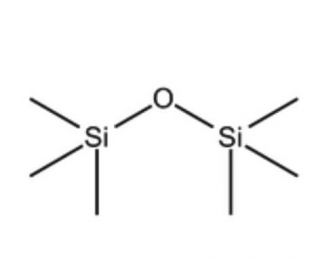

Hexamethyldisiloxane (NMR grade) (CAS 107-46-0)
QUICK LINKS
Hexamethyldisiloxane (NMR grade) is utilized in nuclear magnetic resonance (NMR) spectroscopy as an internal standard or calibration compound due to its well-defined chemical shifts and stability. In research applications involving NMR, it provides a reference for the chemical shift scale, helping in the accurate determination of the magnetic properties of atomic nuclei in other molecules. Hexamethyldisiloxane is also employed as a non-reactive, inert solvent in NMR studies for substances that are not readily soluble in more conventional solvents. Its role in NMR studies of organosilicon compounds is particularly important because it can resonate at chemical shifts similar to the compounds being studied, providing clear baselines for comparison. Furthermore, due to its low viscosity and volatility, hexamethyldisiloxane is useful in sample preparation for NMR experiments, as it can easily be removed after the analysis is complete.
Hexamethyldisiloxane (NMR grade) (CAS 107-46-0) References
- The diffusion of fluoride with hexamethyldisiloxane. | Hall, RJ. 1969. Talanta. 16: 129-33. PMID: 18960478
- Hexamethyldisiloxane-based nanoprobes for (1) H MRI oximetry. | Gulaka, PK., et al. 2011. NMR Biomed. 24: 1226-34. PMID: 21412864
- Applications of Hadamard transform-gas chromatography/mass spectrometry for the detection of hexamethyldisiloxane in a wafer cleanroom. | Cheng, YK., et al. 2012. J Chromatogr A. 1220: 143-6. PMID: 22192564
- Comparison of hexamethyldisiloxane dissociation processes in plasma. | Jauberteau, JL. and Jauberteau, I. 2012. J Phys Chem A. 116: 8840-50. PMID: 22812650
- Response of Plasma-Polymerized Hexamethyldisiloxane Films to Aqueous Environments. | Blanchard, NE., et al. 2015. Langmuir. 31: 12944-53. PMID: 26451512
- Surface Characterization of a Glass Fiber Post after Nonthermal Plasma Treatment with Hexamethyldisiloxane. | de Souza Batista, VE., et al. 2017. J Adhes Dent. 525-533. PMID: 29260804
- Hexamethyldisiloxane cold plasma treatment and amylose content determine the structural, barrier and mechanical properties of starch-based films. | Sifuentes-Nieves, I., et al. 2019. Int J Biol Macromol. 124: 651-658. PMID: 30476514
- Gaseous adsorption of hexamethyldisiloxane on carbons: Isotherms, isosteric heats and kinetics. | Wang, G., et al. 2020. Chemosphere. 247: 125862. PMID: 31955043
- PECVD of Hexamethyldisiloxane Coatings Using Extremely Asymmetric Capacitive RF Discharge. | Gosar, Ž., et al. 2020. Materials (Basel). 13: PMID: 32384729
- The Effects of Hydrophobicity and Textural Properties on Hexamethyldisiloxane Adsorption in Reduced Graphene Oxide Aerogels. | Hou, X., et al. 2021. Molecules. 26: PMID: 33672689
- Unraveling the adsorption and diffusion properties of hexamethyldisiloxane on zeolites by static gravimetric analysis. | Wang, G., et al. 2021. Water Res. 197: 117097. PMID: 33836298
- Silanization of Plasma-Activated Hexamethyldisiloxane-Based Plasma Polymers for Substrate-Independent Deposition of Coatings with Controlled Surface Chemistry. | Egghe, T., et al. 2022. ACS Appl Mater Interfaces. 14: 4620-4636. PMID: 35014795
- Large-Scale Plasma-Polymerized Hexamethyldisiloxane Thin Films: Role of Interelectrode Distance and Excellent Corrosion Resistance. | Wang, Y., et al. 2022. ACS Appl Mater Interfaces. 14: 56169-56175. PMID: 36475578
Ordering Information
| Product Name | Catalog # | UNIT | Price | Qty | FAVORITES | |
Hexamethyldisiloxane (NMR grade), 25 g | sc-505690 | 25 g | $39.00 |