
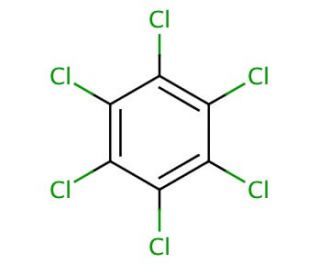

Hexachlorobenzene (CAS 118-74-1)
See product citations (1)
QUICK LINKS
Hexachlorobenzene is a stable, white, crystalline substance that has been used as a fungicide and in the manufacture of dyes, organic chemicals, rubber, and wood preservation. When heated, it emits toxic fumes including carbon monoxide, carbon dioxide, hydrochloric acid, and other chlorinated compounds. In the past, hexachlorobenzene was widely used as a pesticide for protecting onion and sorghum seeds, as well as in the production of fireworks, ammunition, and synthetic rubber. Research has shown that hexachlorobenzene activates specific signaling pathways and promotes cell migration and the expression of metalloproteases (MMPs), which play a role in tumor invasion and metastasis. In animal models, hexachlorobenzene has been found to enhance tumor growth and increase the expression of MMP2 and MMP9 proteins. Furthermore, it stimulates lung metastasis, regardless of the tumor′s hormone-receptor status.
Hexachlorobenzene (CAS 118-74-1) References
- The role of the immune system in hexachlorobenzene-induced toxicity. | Michielsen, CC., et al. 1999. Environ Health Perspect. 107 Suppl 5: 783-92. PMID: 10502545
- Environmental toxicology and health effects associated with hexachlorobenzene exposure. | Reed, L., et al. 2007. Rev Environ Health. 22: 213-43. PMID: 18078005
- Hexachlorobenzene sources, levels and human exposure in the environment of China. | Wang, G., et al. 2010. Environ Int. 36: 122-130. PMID: 19818502
- Biomonitoring equivalents for hexachlorobenzene. | Aylward, LL., et al. 2010. Regul Toxicol Pharmacol. 58: 25-32. PMID: 20547196
- Hexachlorobenzene as a persistent organic pollutant: Toxicity and molecular mechanism of action. | Starek-Świechowicz, B., et al. 2017. Pharmacol Rep. 69: 1232-1239. PMID: 29128804
- The history of hexachlorobenzene accumulation in Svalbard fjords. | Pouch, A., et al. 2018. Environ Monit Assess. 190: 360. PMID: 29799069
- Hexachlorobenzene. | . 1988. Rev Environ Contam Toxicol. 106: 143-54. PMID: 3059406
- Hexachlorobenzene Catabolism Involves a Nucleophilic Aromatic Substitution and Flavin-N5-Oxide Formation. | Adak, S. and Begley, TP. 2019. Biochemistry. 58: 1181-1183. PMID: 30702280
- Hexachlorobenzene: an ecotoxicological profile of an organochlorine compound. | Bro-Rasmussen, F. 1986. IARC Sci Publ. 231-42. PMID: 3298032
- Environmental health risk assessment: hexachlorobenzene. | Krewski, D., et al. 1986. IARC Sci Publ. 621-8. PMID: 3298040
- Toxicity studies of hexachlorobenzene administered by gavage to female Sprague Dawley (Hsd:Sprague Dawley SD) rats. | ,. 2021. Toxic Rep Ser.. PMID: 33687031
- The endocrine disruptor hexachlorobenzene can cause oxidative damage in the testis of mice. | Dou, L., et al. 2021. Andrologia. 53: e14195. PMID: 34374107
- Photochemical transformation of hexachlorobenzene (HCB) in solid-water system: Kinetics, mechanism and toxicity evaluation. | Tu, Z., et al. 2022. Chemosphere. 295: 133907. PMID: 35151701
- Mechanochemical treatment of hexachlorobenzene-contaminated soil with additives. | Li, X. and Chen, H. 2023. Environ Sci Pollut Res Int. 30: 41910-41922. PMID: 36639587
- Hexachlorobenzene as a possible major contributor to the dioxin activity of human milk. | van Birgelen, AP. 1998. Environ Health Perspect. 106: 683-8. PMID: 9799183
Ordering Information
| Product Name | Catalog # | UNIT | Price | Qty | FAVORITES | |
Hexachlorobenzene, 250 mg | sc-255196 | 250 mg | $53.00 | |||
Hexachlorobenzene, 25 g | sc-255196A | 25 g | $378.00 |