
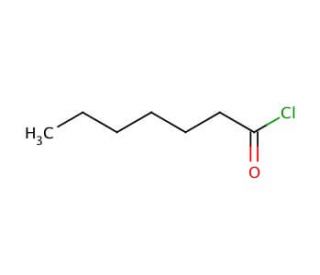

Heptanoyl chloride (CAS 2528-61-2)
QUICK LINKS
Heptanoyl chloride, an organic compound with the molecular formula C7H13ClO, has been extensively studied in scientific research, particularly in the fields of organic chemistry, chemical synthesis, and materials science. Research has focused on elucidating the mechanisms of heptanoyl chloride′s synthesis and its diverse applications. Heptanoyl chloride can be synthesized through the reaction of heptanoic acid with thionyl chloride or oxalyl chloride, leading to the formation of the corresponding acyl chloride. Studies have explored the factors influencing the yield and selectivity of heptanoyl chloride synthesis, such as reaction conditions, stoichiometry, and catalysts. Furthermore, heptanoyl chloride has been utilized as a versatile chemical intermediate in various research applications. It has been investigated for its role in the synthesis of pharmaceutical intermediates, agrochemicals, and functionalized materials. Research has explored its reactivity towards nucleophiles, allowing for the introduction of heptanoyl functional groups into different molecular frameworks. Additionally, heptanoyl chloride has been employed as a cross-linking agent in polymer chemistry, enabling the formation of interconnected networks with improved mechanical properties. The research applications of heptanoyl chloride contribute to advancements in organic synthesis, materials science, and the development of novel compounds. By exploring the mechanisms and applications of heptanoyl chloride, researchers aim to optimize its synthesis methods, discover new synthetic routes, and explore its potential utilization in diverse research areas.
Heptanoyl chloride (CAS 2528-61-2) References
- The C- and N-Terminal Residues of Synthetic Heptapeptide Ion Channels Influence Transport Efficacy Through Phospholipid Bilayers. | Djedovič, N., et al. 2005. New J Chem. 29: 291-305. PMID: 19633728
- Structure-activity relationships of virginiae butanolide C, an inducer of virginiamycin production in Streptomyces virginiae. | Nihira, T., et al. 1988. J Antibiot (Tokyo). 41: 1828-37. PMID: 3145258
- Synthesis and characterization of bioplastic curdlan esters with an introduced flexible carboxylic acid side chain. | Takata, Y. and Kijima, M. 2023. Carbohydr Res. 523: 108732. PMID: 36571946
- Production of aldehydes via electrochemical reduction of acyl halides at mercury and carbon cathodes in acetonitrile. | Urove, Greg A., Dennis G. Peters, and Mohammad S. Mubarak. 1992. The Journal of Organic Chemistry. 57, no. 2: 786-790.
- Lewis Acid Induced Additions to Unsaturated Fatty Compounds III: Alkylaluminium Halide Induced Friedel‐Crafts Acylations of Unsaturated Fatty Compounds. | Biermann, Ursula, and J. O. Metzger. 1992. Lipid/Fett. 94.9: 329-3.
- Electrochemical reduction of cyclohexanecarbonyl chloride at mercury cathodes in acetonitrile. | Urove, Greg A., and Dennis G. Peters. 1993. Journal of the Electrochemical Society. 140.4: 932.
- Fluorescence properties of 1-heptanoylpyrene: a probe for hydrogen bonding in microaggregates and biological membranes. | Armbruster, Clemens, Martin Knapp, Karl Rechthaler, Rudolf Schamschule, Andreas BJ Parusel, Gottfried Köhler, and Wolfgang Wehrmann. 1999. Journal of Photochemistry and Photobiology A: Chemistry. 125, no. 1-3: 29-38.
- Verticilide: elucidation of absolute configuration and total synthesis. | Monma, Souichi, Toshiaki Sunazuka, Kenichiro Nagai, Takahiro Arai, Kazuro Shiomi, Ryosuke Matsui, and Satoshi Ōmura. 2006. Organic letters. 8, no. 24: 5601-5604.
- Synthesis, molecular, and morphological characterization of initial and modified diblock copolymers with organic acid chloride derivatives. | Politakos, Nikolaos,. 2011. Journal of Polymer Science Part A:Polymer Chemistry. 49.19: 4292-4305.
- Electrolytic Reductions of Heptanoyl Chloride, Phthaloyl Dichloride, and Benzoyl Chloride at Carbon and Mercury Cathodes in Acetonitrile. | Urove, Greg A., Mohammad S. Mubarak, and Dennis G. Peters. 2023. Electroorganic Synthesis. Routledge,. 91-98.
Ordering Information
| Product Name | Catalog # | UNIT | Price | Qty | FAVORITES | |
Heptanoyl chloride, 250 ml | sc-215143 | 250 ml | $214.00 |