
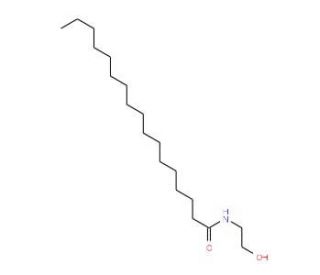

Heptadecanoyl Ethanolamide
QUICK LINKS
Heptadecanoyl Ethanolamide is a fatty acid amide, a class of bioactive lipids that encompasses molecules formed by the condensation of a fatty acid with an amine—in this case, ethanolamine. This compound is structurally similar to other amides such as anandamide, but with a heptadecanoic acid backbone. This specific structure confers unique physical and chemical properties to the molecule, notably influencing its role in cellular signaling pathways. In research, Heptadecanoyl Ethanolamide has been employed to investigate its interactions with various cellular receptors and enzymes that are part of the endocannabinoid system, which plays a critical role in regulating a wide range of physiological processes. Although structurally akin to endocannabinoids, Heptadecanoyl Ethanolamide does not bind to cannabinoid receptors but may interact with other receptors or enzymes involved in lipid signaling pathways, possibly influencing mechanisms such as lipid metabolism and cellular homeostasis. Studies involving this chemical help explain the broader roles of fatty acid ethanolamides in cellular communication and regulation. Researchers focus on understanding how such molecules can affect cell function independently of the traditional cannabinoid pathways, providing deeper insights into the non-cannabinoid roles of related lipid molecules in cellular processes.
Heptadecanoyl Ethanolamide References
- Anti-inflammatory activity on compounds obtained from egg yolk, peanut oil, and soybean lecithin. | GANLEY, OH., et al. 1958. J Lab Clin Med. 51: 709-14. PMID: 13539486
- Human test models for bioequivalence of topical corticosteroids: a review. | Olsen, EA. 1992. Int J Dermatol. 31 Suppl 1: 9-13. PMID: 1428469
- Quantitative profiling of endocannabinoids and related compounds in rat brain using liquid chromatography-tandem electrospray ionization mass spectrometry. | Richardson, D., et al. 2007. Anal Biochem. 360: 216-26. PMID: 17141174
- Analgesic effects of fatty acid amide hydrolase inhibition in a rat model of neuropathic pain. | Jhaveri, MD., et al. 2006. J Neurosci. 26: 13318-27. PMID: 17182782
- An Important Role for N-Acylethanolamine Acid Amidase in the Complete Freund's Adjuvant Rat Model of Arthritis. | Bonezzi, FT., et al. 2016. J Pharmacol Exp Ther. 356: 656-63. PMID: 26769918
- Lipidomic Analysis of Endocannabinoid Signaling: Targeted Metabolite Identification and Quantification. | Keereetaweep, J. and Chapman, KD. 2016. Neural Plast. 2016: 2426398. PMID: 26839710
- Engineering yeast phospholipid metabolism for de novo oleoylethanolamide production. | Liu, Y., et al. 2020. Nat Chem Biol. 16: 197-205. PMID: 31844304
- Heritability and family-based GWAS analyses of the N-acyl ethanolamine and ceramide plasma lipidome. | McGurk, KA., et al. 2021. Hum Mol Genet. 30: 500-513. PMID: 33437986
- Untargeted serum metabolomic profiling for early detection of Schistosoma mekongi infection in mouse model. | Chienwichai, P., et al. 2022. Front Cell Infect Microbiol. 12: 910177. PMID: 36061860
- 'A UHPLC–MS/MS method for determination of N-acylethanolamines in cerebrospinal fluid.' | Ismoilova, Visolakhon,. 2023. bioRxiv. 2023: 11.
Ordering Information
| Product Name | Catalog # | UNIT | Price | Qty | FAVORITES | |
Heptadecanoyl Ethanolamide, 5 mg | sc-221715 | 5 mg | $68.00 | |||
Heptadecanoyl Ethanolamide, 10 mg | sc-221715A | 10 mg | $129.00 |