
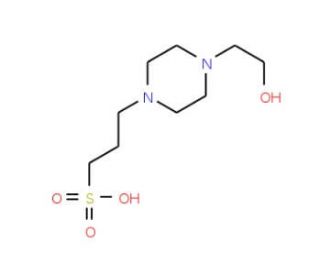

HEPPS (CAS 16052-06-5)
QUICK LINKS
HEPPS, or N-(2-Hydroxyethyl)piperazine-N′-(3-propanesulfonic acid), is a zwitterionic buffering agent commonly used in biochemical and molecular biology research. Its mechanism of action is rooted in its ability to maintain a stable pH environment, crucial for various enzymatic reactions and protein studies. HEPPS is especially favored for its buffering capacity in the physiological pH range, typically between pH 6.8 and 8.2, making it ideal for biological assays and cell culture experiments. This compound is extensively utilized in the preparation of cell culture media, where maintaining a consistent pH is essential for cell viability and growth. Additionally, HEPPS is employed in biochemical assays, such as enzyme kinetics studies, where precise pH control is necessary for accurate measurement of enzymatic activity. Furthermore, HEPPS has found applications in molecular biology techniques, including nucleic acid purification, PCR (polymerase chain reaction), and protein analysis by SDS-PAGE (sodium dodecyl sulfate polyacrylamide gel electrophoresis). Its compatibility with various biological systems and stability under physiological conditions make HEPPS a valuable tool in research laboratories for maintaining optimal pH conditions and ensuring reliable experimental outcomes in a wide range of biochemical and molecular biology studies.
HEPPS (CAS 16052-06-5) References
- Initial characterization of Fom3 from Streptomyces wedmorensis: The methyltransferase in fosfomycin biosynthesis. | Allen, KD. and Wang, SC. 2014. Arch Biochem Biophys. 543: 67-73. PMID: 24370735
- Arabidopsis thaliana phytochelatin synthase 2 is constitutively active in vivo and can rescue the growth defect of the PCS1-deficient cad1-3 mutant on Cd-contaminated soil. | Kühnlenz, T., et al. 2014. J Exp Bot. 65: 4241-53. PMID: 24821959
- Spectroscopic characterization and mechanistic investigation of P-methyl transfer by a radical SAM enzyme from the marine bacterium Shewanella denitrificans OS217. | Allen, KD. and Wang, SC. 2014. Biochim Biophys Acta. 1844: 2135-44. PMID: 25224746
- Crystal structures of Leishmania mexicana arginase complexed with α,α-disubstituted boronic amino-acid inhibitors. | Hai, Y. and Christianson, DW. 2016. Acta Crystallogr F Struct Biol Commun. 72: 300-6. PMID: 27050264
- Boron-Based Inhibitors of the NLRP3 Inflammasome. | Baldwin, AG., et al. 2017. Cell Chem Biol. 24: 1321-1335.e5. PMID: 28943355
- Energetics and Kinetics of S-State Transitions Monitored by Delayed Chlorophyll Fluorescence. | Zaharieva, I. and Dau, H. 2019. Front Plant Sci. 10: 386. PMID: 30984228
- Whole-cell biocatalysis for hydrogen storage and syngas conversion to formate using a thermophilic acetogen. | Schwarz, FM. and Müller, V. 2020. Biotechnol Biofuels. 13: 32. PMID: 32140177
- Batch Studies of Phosphonate and Phosphate Adsorption on Granular Ferric Hydroxide (GFH) with Membrane Concentrate and Its Synthetic Replicas. | Reinhardt, T., et al. 2020. Molecules. 25: PMID: 33182263
- Formate-driven H2 production by whole cells of Thermoanaerobacter kivui. | Burger, Y., et al. 2022. Biotechnol Biofuels Bioprod. 15: 48. PMID: 35545791
- Combinatorial selective ER-phagy remodels the ER during neurogenesis. | Hoyer, MJ., et al. 2024. Nat Cell Biol. 26: 378-392. PMID: 38429475
Ordering Information
| Product Name | Catalog # | UNIT | Price | Qty | FAVORITES | |
HEPPS, 25 g | sc-286008 | 25 g | $61.00 | |||
HEPPS, 100 g | sc-286008A | 100 g | $148.00 |