
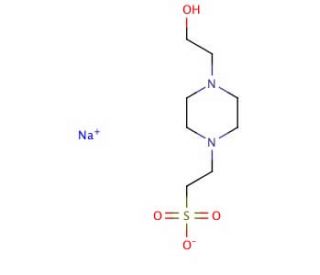

HEPES hemisodium salt (CAS 103404-87-1)
QUICK LINKS
HEPES hemisodium salt is a zwitterionic organic chemical buffering agent commonly used in biological and biochemical research to maintain the pH of solutions within a narrow range, typically between 6.8 and 8.2. This buffer is especially favored in cell culture environments and enzymatic studies due to its minimal interference with biological processes and low metal ion binding properties. The chemical structure of HEPES hemisodium salt allows it to resist changes in pH upon dilution or addition of acids or bases, making it highly effective for maintaining stable environmental conditions during experiments. Its buffering capacity is crucial in applications such as DNA/RNA extraction, protein purification, and other sensitive biochemical assays where pH stability is essential for the accuracy and reproducibility of results. Additionally, HEPES is used in electrophoresis buffers and other media where precise pH control is required to prevent damage to cellular components or alteration in enzyme activity. The use of HEPES hemisodium salt in research has facilitated advancements in understanding cellular mechanisms and protein interactions, owing to its reliability and consistency in creating optimal experimental conditions without perturbing the biological system under study.
HEPES hemisodium salt (CAS 103404-87-1) References
- Quantitation of protein. | Stoscheck, CM. 1990. Methods Enzymol. 182: 50-68. PMID: 2314256
- In vitro neuronal network activity as a new functional diagnostic system to detect effects of Cerebrospinal fluid from autoimmune encephalitis patients. | Koch, H., et al. 2019. Sci Rep. 9: 5591. PMID: 30944364
- Studies on the interference of selected substances with two modifications of the Lowry protein determination. | Himmel, HM. and Heller, W. 1987. J Clin Chem Clin Biochem. 25: 909-13. PMID: 3127532
- Lipid Nanoparticles Containing Mixtures of Antioxidants to Improve Skin Care and Cancer Prevention. | Gonçalves, C., et al. 2021. Pharmaceutics. 13: PMID: 34959324
- Distinct neuronal excitability alterations of medial prefrontal cortex in early-life neglect model of rats. | Zhang, Y., et al. 2022. Animal Model Exp Med. 5: 274-280. PMID: 35748035
- Corticosteroids as Selective and Effective Modulators of Glycine Receptors. | Solntseva, EI., et al. 2023. ACS Chem Neurosci. 14: 3132-3142. PMID: 37584305
- HCN2 Channels in the Ventral Hippocampal CA1 Regulate Nociceptive Hypersensitivity in Mice. | Zheng, Y., et al. 2023. Int J Mol Sci. 24: PMID: 37762124
- Hydrogen ion buffers. | Good, NE. and Izawa, S. 1972. Methods Enzymol. 24: 53-68. PMID: 4206745
- Substitution of 4-(2-hydroxyethyl)-1-piperazineethane sulfonic acid (HEPES) for bicarbonate in protein-free animal cell culture medium: application to vaccinia virus quantitation and fluorogenic acetylesterase assay in living LM cells. | Medzon, EL. and Gedies, A. 1971. Can J Microbiol. 17: 651-3. PMID: 5104240
- Hydrogen ion buffers for biological research. | Good, NE., et al. 1966. Biochemistry. 5: 467-77. PMID: 5942950
Ordering Information
| Product Name | Catalog # | UNIT | Price | Qty | FAVORITES | |
HEPES hemisodium salt, 25 g | sc-235279 | 25 g | $37.00 |