
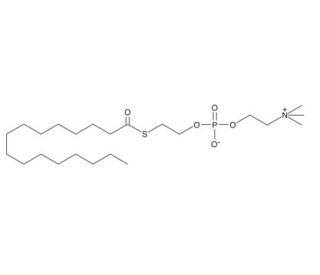

HEPC (CAS 60793-01-3)
QUICK LINKS
HEPC, with the CAS number 60793-01-3, is a phospholipid compound, specifically hydrogenated egg phosphatidylcholine. This molecule consists of a glycerophosphate skeleton esterified with fatty acids and is characteristic of phosphatidylcholines where the fatty acid chains have been hydrogenated to remove double bonds, thereby stabilizing the molecule against oxidative degradation. HEPC is widely utilized in research focusing on the biophysical properties of lipid bilayers and liposomes. Its ability to form stable bilayers in aqueous environments makes it a valuable model for studying membrane dynamics, permeability, and interactions with other molecules such as proteins, drugs, and other lipids. In the field of nanotechnology, HEPC is employed in the development of liposomal delivery systems, which are used to encapsulate and transport molecules, demonstrating its utility in elucidating the mechanisms of molecule-lipid interactions and membrane-fusion processes. These characteristics make HEPC an essential tool in the study of membrane-associated phenomena and the creation of more efficient delivery vehicles in non-medical applications, such as in food science for encapsulating nutrients and in cosmetics for the delivery of active ingredients. Through these applications, research involving HEPC significantly contributes to advancements in materials science and industrial biotechnology.
HEPC (CAS 60793-01-3) References
- Inverse association between phospholipase A2 and COX-2 expression during mouse colon tumorigenesis. | Dong, M., et al. 2003. Carcinogenesis. 24: 307-15. PMID: 12584182
- Inhibition of phospholipase A(2) activity by conjugated linoleic acids in human macrophages. | Stachowska, E., et al. 2007. Eur J Nutr. 46: 28-33. PMID: 17164980
- Lipid chain selectivity by outer membrane phospholipase A. | Stanley, AM., et al. 2007. J Mol Biol. 366: 461-8. PMID: 17174333
- The role of a hydrogen bonding network in the transmembrane beta-barrel OMPLA. | Stanley, AM. and Fleming, KG. 2007. J Mol Biol. 370: 912-24. PMID: 17555765
- Outer membrane phospholipase a dimer stability does not correlate to occluded surface area. | Ebie Tan, A. and Fleming, KG. 2008. Biochemistry. 47: 12095-103. PMID: 18939857
- Modulating bilayer mechanical properties to promote the coupled folding and insertion of an integral membrane protein. | Herrmann, M., et al. 2015. Eur Biophys J. 44: 503-12. PMID: 26016666
- Real-time Visualization of Phospholipid Degradation by Outer Membrane Phospholipase A using High-Speed Atomic Force Microscopy. | Rangl, M., et al. 2017. J Mol Biol. 429: 977-986. PMID: 28283404
- Comparative analysis of allergen genes and pro-inflammatory factors in pollen and fruit of apple varieties. | Paris, R., et al. 2017. Plant Sci. 264: 57-68. PMID: 28969803
- Self-Assembly of Protein-Containing Lipid-Bilayer Nanodiscs from Small-Molecule Amphiphiles. | Mahler, F., et al. 2021. Small. 17: e2103603. PMID: 34674382
- A continuous spectrophotometric assay for membrane-bound lysophospholipases using a thioester substrate analog. | Aarsman, AJ. and Van den Bosch, H. 1977. FEBS Lett. 79: 317-20. PMID: 891946
Ordering Information
| Product Name | Catalog # | UNIT | Price | Qty | FAVORITES | |
HEPC, 5 mg | sc-205339 | 5 mg | $200.00 | |||
HEPC, 10 mg | sc-205339A | 10 mg | $350.00 |