
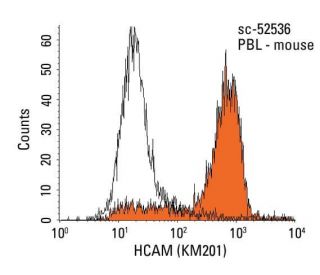

CD44 Antibody (KM201): sc-52536
- CD44 Antibody (KM201) is a rat monoclonal IgG1 provided at 100 µg/ml
- recommended for detection of HCAM of mouse origin by WB, IP and FCM
- available conjugated to either phycoerythrin or FITC for IF, IHC(P) and FCM
- See CD44 (DF1485): sc-7297 for CD44 antibody conjugates, including AC, HRP, FITC, PE, Alexa Fluor® 488, 594, 647, 680 and 790.
- At present, we have not yet completed the identification of the preferred secondary detection reagent(s) for CD44 Antibody (KM201). This work is in progress.

QUICK LINKS
SEE ALSO...
HCAM Antibody (KM201) is a rat monoclonal IgG1 antibody that detects HCAM in mouse samples through applications such as western blotting (WB), immunoprecipitation (IP), and flow cytometry (FCM). HCAM, also known as CD44, is a critical cell adhesion molecule that plays a vital role in various biological processes, including hematopoiesis, lymphocyte activation, and tumor metastasis. This 742 amino acid single-pass type I membrane protein functions primarily as a receptor for hyaluronic acid (HA) and interacts with ligands such as osteopontin (OPN), facilitating essential cell-cell and cell-matrix interactions that are crucial for cell adhesion and migration. HCAM′s structure includes a Link domain, and due to alternative splicing, HCAM is expressed in multiple isoforms, including CD44R, CDw44, CD44S, CD44H (hematopoietic), and CD44E (epithelial). Notably, the CD44H isoform is highly expressed in cancer tissues, indicating significant involvement in tumor progression and highlighting HCAM′s importance in cancer biology. With the ability to provide insights into cell adhesion mechanisms and tumor dynamics, anti-HCAM antibody (KM201) is an invaluable tool for researchers studying these critical processes in mouse models.
Alexa Fluor® is a trademark of Molecular Probes Inc., OR., USA
LI-COR® and Odyssey® are registered trademarks of LI-COR Biosciences
CD44 Antibody (KM201) References:
- The adhesion molecules NCAM, HCAM, PECAM-1 and ICAM-1 in normal salivary gland tissues and salivary gland malignancies. | Perschbacher, K., et al. 2004. J Oral Pathol Med. 33: 230-6. PMID: 15061711
- CD44, a therapeutic target for metastasising tumours. | Orian-Rousseau, V. 2010. Eur J Cancer. 46: 1271-7. PMID: 20303742
- Expression and Function of CD44 in Epithelial Ovarian Carcinoma. | Sacks, JD. and Barbolina, MV. 2015. Biomolecules. 5: 3051-66. PMID: 26569327
- Atomistic fingerprint of hyaluronan-CD44 binding. | Vuorio, J., et al. 2017. PLoS Comput Biol. 13: e1005663. PMID: 28715483
- Androgen Receptor Regulates CD44 Expression in Bladder Cancer. | Sottnik, JL., et al. 2021. Cancer Res. 81: 2833-2846. PMID: 33687952
- CD44 expressed by myeloid cells promotes glioma invasion. | Ivanova, EL., et al. 2022. Front Oncol. 12: 969787. PMID: 35992852
- STAT5A modulates gastric cancer progression via upregulation of CD44. | Wang, S., et al. 2023. Genomics. 115: 110638. PMID: 37196931
- CD44-Based Detection of CSCs: CD44 Immunodetection by Flow Cytometry. | Seeneevassen, L., et al. 2024. Methods Mol Biol. 2777: 71-81. PMID: 38478336
- Neoplastic human tissue mast cells express the adhesion molecule CD44/HCAM. | Horny, HP., et al. 1996. Virchows Arch. 429: 91-4. PMID: 8917709
- CD44 and the adhesion of neoplastic cells. | Rudzki, Z. and Jothy, S. 1997. Mol Pathol. 50: 57-71. PMID: 9231152
Ordering Information
| Product Name | Catalog # | UNIT | Price | Qty | FAVORITES | |
CD44 Antibody (KM201) | sc-52536 | 100 µg/ml | $322.00 | |||
CD44 Antibody (KM201) FITC | sc-52536 FITC | 100 tests in 2 ml | $336.00 | |||
CD44 Antibody (KM201) PE | sc-52536 PE | 100 tests in 2 ml | $349.00 |