
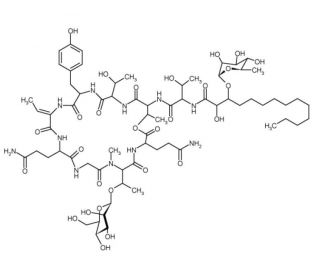

Hassallidin B
QUICK LINKS
Hassallidin B, a cyclic peptide isolated from the cyanobacterium Hassallia sp., has attracted significant interest in scientific research due to its potent antimicrobial activity and unique mechanism of action. This compound exhibits antimicrobial properties by disrupting bacterial cell membrane integrity. Research indicates that Hassallidin B specifically targets bacterial membranes, leading to membrane depolarization and permeabilization, ultimately causing cell lysis and death. Furthermore, studies have explored the potential of Hassallidin B as a tool compound in membrane biology research, facilitating the investigation of bacterial membrane structure and function. Additionally, Hassallidin B has been investigated for its potential applications in agriculture as a biocontrol agent to combat plant pathogens. Its mechanism of action against bacteria makes it a promising candidate for further research into novel antimicrobial agents and agricultural bioproducts. Moreover, the structural complexity of Hassallidin B has sparked interest in synthetic chemistry, driving efforts to develop efficient synthetic routes for its production and analog synthesis. Overall, Hassallidin B represents a valuable asset in antimicrobial research, offering insights into membrane-targeting antimicrobial strategies and potential applications in agriculture and synthetic chemistry.
Hassallidin B References
- Hassallidin B--second antifungal member of the Hassallidin family. | Neuhof, T., et al. 2006. Bioorg Med Chem Lett. 16: 4220-2. PMID: 16777415
- Hassallidins, antifungal glycolipopeptides, are widespread among cyanobacteria and are the end-product of a nonribosomal pathway. | Vestola, J., et al. 2014. Proc Natl Acad Sci U S A. 111: E1909-17. PMID: 24742428
- A comprehensive review of glycosylated bacterial natural products. | Elshahawi, SI., et al. 2015. Chem Soc Rev. 44: 7591-697. PMID: 25735878
- Antibacterial, antifungal and antimycobacterial compounds from cyanobacteria. | Swain, SS., et al. 2017. Biomed Pharmacother. 90: 760-776. PMID: 28419973
- Recent Advances in Exploration and Biotechnological Production of Bioactive Compounds in Three Cyanobacterial Genera: Nostoc, Lyngbya, and Microcystis. | Thuan, NH., et al. 2019. Front Chem. 7: 604. PMID: 31552222
- Identification of Collimonas gene loci involved in the biosynthesis of a diffusible secondary metabolite with broad-spectrum antifungal activity and plant-protective properties. | Akum, FN., et al. 2021. Microb Biotechnol. 14: 1367-1384. PMID: 33347710
- Cyanobacteria: A Promising Source of Antifungal Metabolites. | do Amaral, SC., et al. 2023. Mar Drugs. 21: PMID: 37367684
- Recent Advances in Polypeptide Antibiotics Derived from Marine Microorganisms. | Wang, W., et al. 2023. Mar Drugs. 21: PMID: 37888482
- 'Cyanobacteria as valuable tool in biotechnology.' | Śliżewska, Agnieszka, and Ewa Żymańczyk-Duda. 2021. Catalysts. 11.11: 1259.
Ordering Information
| Product Name | Catalog # | UNIT | Price | Qty | FAVORITES | |
Hassallidin B, 50 µg | sc-221706 | 50 µg | $115.00 |