
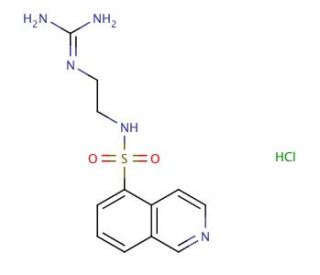

Molecular structure of HA-1004 hydrochloride, CAS Number: 92564-34-6
HA-1004 hydrochloride (CAS 92564-34-6)
Alternate Names:
N-(2-Guanidinoethyl)-5-isoquinolinesulfonamide hydrochloride
Application:
HA-1004 hydrochloride is an inhibitor of PKA, PKC, cGKI, MYLK, and calcium channel protein
CAS Number:
92564-34-6
Molecular Weight:
329.81
Molecular Formula:
C12H15N5O2S•HCl
For Research Use Only. Not Intended for Diagnostic or Therapeutic Use.
* Refer to Certificate of Analysis for lot specific data.
QUICK LINKS
Ordering Information
Description
Technical Information
Safety Information
SDS & Certificate of Analysis
HA-1004 hydrochloride, also known as N-(2-Guanidinoethyl)-5-isoquinolinesulfonamide hydrochloride, is a water-soluble and colorless solid. It is an intermediate in the synthesis of various other substances and is derived from the amino acid guanidinoacetic acid. This compound functions by suppressing the action of particular enzymes, such as cyclooxygenases and lipoxygenases, that are implicated in the creation of pro-inflammatory molecules. Moreover, it has been observed that HA-1004 hydrochloride inhibits specific transcription factors, which could be associated with its anti-inflammatory properties.
HA-1004 hydrochloride (CAS 92564-34-6) References
- Signal transduction during antibody-dependent cellular cytotoxicity mediated by U937 cells. | Serebrinsky, GP. and Isturiz, MA. 1992. Immunol Lett. 31: 53-7. PMID: 1312511
- Role of protein kinase-C in thymocyte apoptosis induced by irradiation. | Ojeda, F., et al. 1992. Int J Radiat Biol. 61: 663-7. PMID: 1349630
- Cross-talk between protein kinase A and mitogen-activated protein kinases signalling in the adaptive changes observed during morphine withdrawal in the heart. | Almela, P., et al. 2009. J Pharmacol Exp Ther. 330: 771-82. PMID: 19567779
- Lidocaine-induced apoptosis of gingival fibroblasts: participation of cAMP and PKC activity. | Villarruel, EQ., et al. 2011. Cell Biol Int. 35: 783-8. PMID: 21047305
- cAMP mediates IL-1-induced lymphocyte penetration through endothelial monolayers. | Turunen, JP., et al. 1990. J Immunol. 145: 4192-7. PMID: 2175325
- Crosstalk between G protein-coupled receptors (GPCRs) and tyrosine kinase receptor (TXR) in the heart after morphine withdrawal. | Almela, P., et al. 2013. Front Pharmacol. 4: 164. PMID: 24409147
- The vasorelaxant effects of milrinone and other vasodilators are attenuated by ouabain. | Harris, AL., et al. 1988. Eur J Pharmacol. 145: 133-9. PMID: 2832186
- Antibronchoconstrictor activity of the intracellular calcium antagonist HA 1004 in guinea pigs. | Chapman, RW., et al. 1988. Pharmacology. 37: 187-94. PMID: 2906438
- Relaxation of vascular smooth muscle by HA-1004, an inhibitor of cyclic nucleotide-dependent protein kinase. | Ishikawa, T., et al. 1985. J Pharmacol Exp Ther. 235: 495-9. PMID: 2997436
- The effects of HA compound calcium antagonists on delayed cerebral vasospasm in dogs. | Takayasu, M., et al. 1986. J Neurosurg. 65: 80-5. PMID: 3712031
- Contraction of smooth muscle in Ca-free solution. | Ashoori, F., et al. 1985. Nihon Heikatsukin Gakkai Zasshi. 21: 57-69. PMID: 4057713
- Shape changes and chemokinesis of Walker carcinosarcoma cells: effects of protein kinase inhibitors (HA-1004, polymyxin B, sangivamycin and tamoxifen) and an inhibitor of diacylglycerol kinase (R 59022). | Zimmermann, A. and Keller, H. 1993. Anticancer Res. 13: 347-54. PMID: 8390801
- Protein kinase C and mouse sciatic nerve regeneration. | Wiklund, P., et al. 1996. Brain Res. 715: 145-54. PMID: 8739633
- Desensitisation of the adenosine A1 receptor by the A2A receptor in the rat striatum. | Dixon, AK., et al. 1997. J Neurochem. 69: 315-21. PMID: 9202325
- Nuclear translocation of the Y-box binding protein by ultraviolet irradiation. | Koike, K., et al. 1997. FEBS Lett. 417: 390-4. PMID: 9409758
Inhibitor of:
Calcium Channel Protein, cGKI, MYLK, PKA, PKC, and Ser/Thr Protein Kinase.Ordering Information
| Product Name | Catalog # | UNIT | Price | Qty | FAVORITES | |
HA-1004 hydrochloride, 10 mg | sc-391033 | 10 mg | $906.00 |