
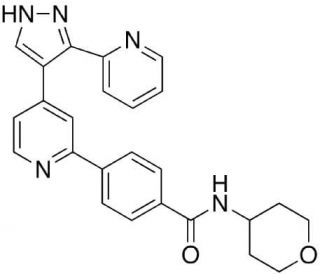

GW788388 (CAS 452342-67-5)
QUICK LINKS
Nup98 Inhibitors are a class of chemical compounds that specifically target the nuclear pore complex protein Nup98. Nup98 is an essential component of the nuclear pore complex (NPC), which is responsible for regulating the transport of molecules between the nucleus and the cytoplasm in eukaryotic cells. Nup98 is involved in various critical cellular processes, including mRNA export, gene expression regulation, and the maintenance of nuclear integrity. It plays a dual role by acting as both a structural component of the NPC and a mobile entity that interacts with chromatin and transcription factors, influencing gene expression. Inhibitors of Nup98 are of significant interest in scientific research because they provide a tool to explore the functional dynamics of the nuclear-cytoplasmic transport system and its impact on cellular homeostasis. The inhibition of Nup98 can disrupt the normal function of the nuclear pore complex, leading to altered nuclear-cytoplasmic transport and potentially affecting the localization and function of key regulatory proteins and RNAs. This can have broad implications for understanding the mechanisms of gene regulation and the cellular response to environmental changes. Researchers utilize Nup98 Inhibitors to investigate how the disruption of nuclear transport influences various cellular pathways, particularly those involving the coordination of gene expression and signaling. Additionally, Nup98 is known to interact with multiple other nuclear pore proteins (nucleoporins), and its inhibition may provide insights into the broader network of interactions within the nuclear pore complex. By studying the effects of Nup98 inhibition, scientists can gain a deeper understanding of nuclear transport mechanisms, the regulation of gene expression, and the maintenance of nuclear architecture, all of which are fundamental to cellular function and adaptation.
GW788388 (CAS 452342-67-5) References
- Transforming growth factor-β promotes basement membrane fibrosis, alters perivascular cerebrospinal fluid distribution, and worsens neurological recovery in the aged brain after stroke. | Howe, MD., et al. 2019. Geroscience. 41: 543-559. PMID: 31721012
- Ochratoxin A induces epithelial-to-mesenchymal transition and renal fibrosis through TGF-β/Smad2/3 and Wnt1/β-catenin signaling pathways in vitro and in vivo. | Pyo, MC., et al. 2020. Arch Toxicol. 94: 3329-3342. PMID: 32617660
- Generation and characterization of iPSC-derived renal proximal tubule-like cells with extended stability. | Chandrasekaran, V., et al. 2021. Sci Rep. 11: 11575. PMID: 34078926
- Temporal transcriptomic alterations of cadmium exposed human iPSC-derived renal proximal tubule-like cells. | Singh, P., et al. 2021. Toxicol In Vitro. 76: 105229. PMID: 34352368
Ordering Information
| Product Name | Catalog # | UNIT | Price | Qty | FAVORITES | |
GW788388, 5 mg | sc-363544 | 5 mg | $95.00 | |||
GW788388, 25 mg | sc-363544A | 25 mg | $384.00 |