
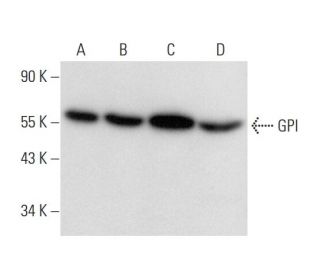
GPI Antibody (H-10): sc-365066
- GPI Antibody (H-10) is a mouse monoclonal IgG3 κ GPI antibody, cited in 7 publications, provided at 200 µg/ml
- specific for an epitope mapping between amino acids 67-102 near the N-terminus of GPI of human origin
- recommended for detection of GPI of mouse, rat and human origin by WB, IP, IF and ELISA; also reactive with additional species, including porcine
- m-IgG3 BP-HRP is the preferred secondary detection reagent for GPI Antibody (H-10) for WB applications. This reagent is now offered in a bundle with GPI Antibody (H-10) (see ordering information below).

QUICK LINKS
SEE ALSO...
GPI Antibody (H-10) is a mouse monoclonal IgG3 kappa light chain antibody that detects GPI protein of mouse, rat, and human origin by western blotting (WB), immunoprecipitation (IP), immunofluorescence (IF), and enzyme-linked immunosorbent assay (ELISA). Anti-GPI antibody (H-10) is available as the non-conjugated form. Glucose-6-phosphate isomerase (GPI), also known as Phosphohexose isomerase (PHI), Neuroleukin (NLK), and Spermantigen-36 (SA-36), plays a crucial role in cellular metabolism by catalyzing the reversible conversion of glucose-6-phosphate to fructose-6-phosphate, a key step in both glycolysis and gluconeogenesis. This enzymatic function maintains energy homeostasis in cells, particularly in tissues with high metabolic demands, such as the brain and muscles. GPI also acts as a neurotrophic factor, supporting the survival and growth of spinal and sensory neurons, which underscores GPI′s importance in neurodevelopment and neuroprotection. Defects or mutations in the GPI gene can lead to serious health issues, including hereditary nonspherocytic hemolytic anemia, hydrops fetalis, immediate neonatal death, and neurological impairments, highlighting GPI′s critical nature in both metabolic and neurological contexts.
Alexa Fluor® is a trademark of Molecular Probes Inc., OR., USA
LI-COR® and Odyssey® are registered trademarks of LI-COR Biosciences
GPI Antibody (H-10) References:
- Glucose-6-phosphate isomerase is not a specific autoantigen in rheumatoid arthritis. | Herve, CA., et al. 2003. Rheumatology (Oxford). 42: 986-8. PMID: 12730513
- Glucose-6-phosphate isomerase is necessary for embryo implantation in the domestic ferret. | Schulz, LC. and Bahr, JM. 2003. Proc Natl Acad Sci U S A. 100: 8561-6. PMID: 12826606
- Detection of antibodies against glucose 6-phosphate isomerase in synovial fluid of rheumatoid arthritis using surface plasmon resonance (BIAcore). | Kim, JY., et al. 2003. Exp Mol Med. 35: 310-6. PMID: 14508072
- Immunization with glucose-6-phosphate isomerase induces T cell-dependent peripheral polyarthritis in genetically unaltered mice. | Schubert, D., et al. 2004. J Immunol. 172: 4503-9. PMID: 15034067
- The crystal structure of mouse phosphoglucose isomerase at 1.6A resolution and its complex with glucose 6-phosphate reveals the catalytic mechanism of sugar ring opening. | Solomons, JT., et al. 2004. J Mol Biol. 342: 847-60. PMID: 15342241
- Glucose-6-phosphate isomerase variants play a key role in the generation of anti-GPI antibodies: possible mechanism of autoantibody production. | Muraki, Y., et al. 2004. Biochem Biophys Res Commun. 323: 518-22. PMID: 15369782
- Raised levels of anti-glucose-6-phosphate isomerase IgG in serum and synovial fluid from patients with inflammatory arthritis. | Schaller, M., et al. 2005. Ann Rheum Dis. 64: 743-9. PMID: 15458959
- Elevated serum glucose-6-phosphate isomerase correlates with histological disease activity and clinical improvement after initiation of therapy in patients with rheumatoid arthritis. | Dai, L., et al. 2010. J Rheumatol. 37: 2452-61. PMID: 20810510
- Peptidylarginine deiminase type 4 deficiency reduced arthritis severity in a glucose-6-phosphate isomerase-induced arthritis model. | Seri, Y., et al. 2015. Sci Rep. 5: 13041. PMID: 26293116
- Two novel mutations (p.(Ser160Pro) and p.(Arg472Cys)) causing glucose-6-phosphate isomerase deficiency are associated with erythroid dysplasia and inappropriately suppressed hepcidin. | Mojzikova, R., et al. 2018. Blood Cells Mol Dis. 69: 23-29. PMID: 28803808
- Glucosephosphate isomerase (GPI) deficiency mutations associated with hereditary nonspherocytic hemolytic anemia (HNSHA). | Beutler, E., et al. 1997. Blood Cells Mol Dis. 23: 402-9. PMID: 9446754
- Molecular basis of neurological dysfunction coupled with haemolytic anaemia in human glucose-6-phosphate isomerase (GPI) deficiency. | Kugler, W., et al. 1998. Hum Genet. 103: 450-4. PMID: 9856489
Ordering Information
| Product Name | Catalog # | UNIT | Price | Qty | FAVORITES | |
GPI Antibody (H-10) | sc-365066 | 200 µg/ml | $322.00 | |||
GPI Antibody (H-10): m-IgG3 BP-HRP Bundle | sc-550565 | 200 µg Ab; 40 µg BP | $361.00 | |||
GPI (H-10) Neutralizing Peptide | sc-365066 P | 100 µg/0.5 ml | $69.00 |