
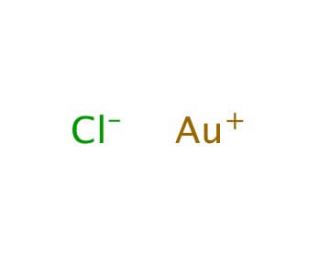

Molecular structure of Gold(I) chloride, CAS Number: 10294-29-8
Gold(I) chloride (CAS 10294-29-8)
Alternate Names:
Gold monochloride; Aurous chloride
CAS Number:
10294-29-8
Molecular Weight:
232.42
Molecular Formula:
AuCl
Supplemental Information:
This is classified as a Dangerous Good for transport and may be subject to additional shipping charges.
For Research Use Only. Not Intended for Diagnostic or Therapeutic Use.
* Refer to Certificate of Analysis for lot specific data.
QUICK LINKS
Ordering Information
Description
Technical Information
Safety Information
SDS & Certificate of Analysis
Gold(I) chloride serves as a catalyst for the synthesis of organic compounds, a reagent for the production of inorganic compounds, and a reducing agent in the creation of metal-containing compounds. Gold(I) chloride plays a vital role in catalytic reaction studies and the exploration of coordination chemistry. The characteristic of Gold(I) chloride as a Lewis acid allows it to accept a pair of electrons, facilitating reactions with other molecules and the formation of complexes. Gold(I) chloride exhibits redox properties, enabling it to function as either an oxidizing agent or a reducing agent.
Gold(I) chloride (CAS 10294-29-8) References
- Two thiourea-containing gold(I) complexes. | Piro, OE., et al. 2002. Acta Crystallogr C. 58: M252-5. PMID: 11932534
- Gold(I) complexes determine apoptosis with limited oxidative stress in Jurkat T cells. | Rigobello, MP., et al. 2008. Eur J Pharmacol. 582: 26-34. PMID: 18242600
- [μ-1,2-Bis(diphenyl-phosphan-yl)-1,2-diethyl-hydrazine-κP:P']bis-[chlorido-gold(I)] tetra-hydro-furan disolvate. | Kriel, FH., et al. 2011. Acta Crystallogr Sect E Struct Rep Online. 67: m155. PMID: 21522837
- Atom-efficient gold(I)-chloride-catalyzed synthesis of α-sulfenylated carbonyl compounds from propargylic alcohols and aryl thiols: substrate scope and experimental and theoretical mechanistic investigation. | Biswas, S., et al. 2013. Chemistry. 19: 17939-50. PMID: 24272980
- An Alternative Reaction Course in O-Glycosidation with O-Glycosyl Trichloroacetimidates as Glycosyl Donors and Lewis Acidic Metal Salts as Catalyst: Acid-Base Catalysis with Gold Chloride-Glycosyl Acceptor Adducts. | Peng, P. and Schmidt, RR. 2015. J Am Chem Soc. 137: 12653-9. PMID: 26360298
- Synthesis, Characterization, and Luminescence Studies of Gold(I) Complexes with PNP- and PNB-Based Ligand Systems. | Pal, S., et al. 2015. Inorg Chem. 54: 10172-83. PMID: 26451952
- Molecular Gold Wire from Mixed-Valent Au(I/III) Complexes. | Böge, M. and Heck, J. 2016. Chemistry. 22: 6787-92. PMID: 27032070
- Gold(I) Carbenoids: On-Demand Access to Gold(I) Carbenes in Solution. | Sarria Toro, JM., et al. 2017. Angew Chem Int Ed Engl. 56: 1859-1863. PMID: 28090747
- Synthesis and molecular structure of biologically significant bis(1,3-dimesityl-4,5-naphthoquinoimidazol-2-ylidene)gold(I) complexes with chloride and dichloridoaurate counter-ions. | Selvakumar, J., et al. 2019. Acta Crystallogr C Struct Chem. 75: 462-468. PMID: 30957792
- Balancing Bulkiness in Gold(I) Phosphino-triazole Catalysis. | Zhao, Y., et al. 2019. European J Org Chem. 2019: 5540-5548. PMID: 31598094
- Synthesis of N-heterocyclic carbene gold(I) complexes. | Nahra, F., et al. 2021. Nat Protoc. 16: 1476-1493. PMID: 33504989
- Silver-Free Au(I) Catalysis Enabled by Bifunctional Urea- and Squaramide-Phosphine Ligands via H-Bonding. | Franchino, A., et al. 2021. Chemistry. 27: 11989-11996. PMID: 34018646
- Cationic gold(I)-catalyzed glycosylation with glycosyl N-1,1-dimethylpropargyl carbamate donors. | Gurung, PB., et al. 2022. Org Biomol Chem. 20: 7006-7010. PMID: 36000552
- Silver-Free Gold-Catalyzed Heterocyclizations through Intermolecular H-Bonding Activation. | Elías-Rodríguez, P., et al. 2023. J Org Chem. 88: 2487-2492. PMID: 36704838
Ordering Information
| Product Name | Catalog # | UNIT | Price | Qty | FAVORITES | |
Gold(I) chloride, 1 g | sc-228263 | 1 g | $270.00 |