
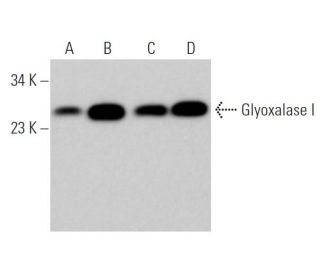
Glyoxalase I Antibody (H-3): sc-271556
- Glyoxalase I Antibody (H-3) is a mouse monoclonal IgG3 κ, cited in 1 publications, provided at 200 µg/ml
- specific for an epitope mapping between amino acids 101-136 within an internal region of Glyoxalase I of human origin
- recommended for detection of Glyoxalase I of mouse, rat and human origin by WB, IP, IF, IHC(P) and ELISA
- m-IgGκ BP-HRP is the preferred secondary detection reagent for Glyoxalase I Antibody (H-3) for WB and IHC(P) applications. This reagent is now offered in a bundle with Glyoxalase I Antibody (H-3) (see ordering information below). For additional m-IgGκ BP conjugates see our complete list of Mouse IgG Binding Proteins.

QUICK LINKS
Glyoxalase I Antibody (H-3) is a mouse monoclonal IgG3 antibody that detects Glyoxalase I in mouse, rat, and human samples through various applications including western blotting (WB), immunoprecipitation (IP), immunofluorescence (IF), immunohistochemistry, and enzyme-linked immunosorbent assay (ELISA). Glyoxalase I (GLO1) plays a crucial role in the detoxification of glucose degradation products, which is vital for cellular health and metabolic balance. GLO1 helps mitigate the harmful effects of reactive carbonyl species that arise from glucose metabolism during oxidative stress. GLO1 exists in three isoforms, generated from two alleles in the genome, forming two homodimers and one heterodimer, with each subunit binding a zinc ion essential for enzymatic activity. GLO1 expression has been shown to be induced in colon carcinoma, highlighting GLO1′s potential role in cancer biology. The presence of an insulin response element and a zinc metal response element in the GLO1 gene promoter region suggests expression is tightly regulated by metabolic signals, making anti-Glyoxalase I antibody (H-3) a valuable tool for researchers exploring GLO1′s functional implications in various biological contexts.
Alexa Fluor® is a trademark of Molecular Probes Inc., OR., USA
LI-COR® and Odyssey® are registered trademarks of LI-COR Biosciences
Glyoxalase I Antibody (H-3) References:
- Protecting the genome: defence against nucleotide glycation and emerging role of glyoxalase I overexpression in multidrug resistance in cancer chemotherapy. | Thornalley, PJ. 2003. Biochem Soc Trans. 31: 1372-7. PMID: 14641066
- Glyoxalase-I mRNA expression and CCK-4 induced panic attacks. | Eser, D., et al. 2011. J Psychiatr Res. 45: 60-3. PMID: 20542521
- Evaluation of potential flavonoid inhibitors of glyoxalase-I based on virtual screening and in vitro studies. | Yadav, A., et al. 2016. J Biomol Struct Dyn. 34: 993-1007. PMID: 26108947
- Novel bivalent inhibitors with sub-nanomolar affinities towards human glyoxalase I. | Sang, Y., et al. 2015. Bioorg Med Chem Lett. 25: 4724-4727. PMID: 26320622
- Oxidative stress and glyoxalase I activity mediate dicarbonyl toxicity in MCF-7 mamma carcinoma cells and a tamoxifen resistant derivative. | Nass, N., et al. 2016. Biochim Biophys Acta. 1860: 1272-80. PMID: 26971627
- A nuclear-localized rice glyoxalase I enzyme, OsGLYI-8, functions in the detoxification of methylglyoxal in the nucleus. | Kaur, C., et al. 2017. Plant J. 89: 565-576. PMID: 27797431
- Combination of pharmacophore modeling and 3D-QSAR analysis of potential glyoxalase-I inhibitors as anticancer agents. | Al-Sha'er, MA., et al. 2019. Comput Biol Chem. 80: 102-110. PMID: 30947068
- Effect of piceatannol-rich passion fruit seed extract on human glyoxalase I-mediated cancer cell growth. | Yamamoto, T., et al. 2019. Biochem Biophys Rep. 20: 100684. PMID: 31517069
- Zn2+ dependent glyoxalase I plays the major role in methylglyoxal detoxification and salinity stress tolerance in plants. | Batth, R., et al. 2020. PLoS One. 15: e0233493. PMID: 32453778
- 1,8 cineole protects type 2 diabetic rats against diabetic nephropathy via inducing the activity of glyoxalase-I and lowering the level of transforming growth factor-1β. | Mahdavifard, S. and Nakhjavani, M. 2022. J Diabetes Metab Disord. 21: 567-572. PMID: 35673442
Ordering Information
| Product Name | Catalog # | UNIT | Price | Qty | FAVORITES | |
Glyoxalase I Antibody (H-3) | sc-271556 | 200 µg/ml | $322.00 | |||
Glyoxalase I Antibody (H-3): m-IgGκ BP-HRP Bundle | sc-521979 | 200 µg Ab, 40 µg BP | $361.00 | |||
Glyoxalase I (H-3) Neutralizing Peptide | sc-271556 P | 100 µg/0.5 ml | $69.00 |