
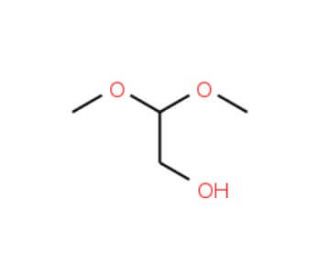

Molecular structure of Glycolaldehyde dimethyl acetal, CAS Number: 30934-97-5
Glycolaldehyde dimethyl acetal (CAS 30934-97-5)
Alternate Names:
2,2-Dimethoxyethanol
CAS Number:
30934-97-5
Molecular Weight:
106.12
Molecular Formula:
C4H10O3
For Research Use Only. Not Intended for Diagnostic or Therapeutic Use.
* Refer to Certificate of Analysis for lot specific data.
QUICK LINKS
Ordering Information
Description
Technical Information
Safety Information
SDS & Certificate of Analysis
Glycolaldehyde dimethyl acetal is a chemical of interest in synthetic organic chemistry, mainly as a protected form of glycolaldehyde, which is a versatile building block for the synthesis of more complex molecules. It is employed in the preparation of diverse heterocyclic compounds, as it can undergo selective reactions to form targeted chemical structures. In carbohydrate chemistry, researchers use it to extend sugar chains through glycosylation reactions, which are for the synthesis of natural products and understanding the structure of oligosaccharides. The compound is also useful in the study of reaction mechanisms, providing insight into acetal formation and hydrolysis under various conditions.
Glycolaldehyde dimethyl acetal (CAS 30934-97-5) References
- Regioselective incorporation of backbone constraints compatible with traditional solid-phase peptide synthesis. | La Venia, A., et al. 2013. ACS Comb Sci. 15: 59-72. PMID: 23240832
- Polymer-supported stereoselective synthesis of tetrahydrobenzopyrazino-thiadiazinone dioxides via N-sulfonyl iminiums. | Cankařová, N., et al. 2014. ACS Comb Sci. 16: 293-302. PMID: 24575715
- Privileged structures as peptide backbone constraints: polymer-supported stereoselective synthesis of benzimidazolinopiperazinone peptides. | Ventosa-Andrés, P., et al. 2014. ACS Comb Sci. 16: 359-66. PMID: 24725105
- Impact of Macroporosity on Catalytic Upgrading of Fast Pyrolysis Bio-Oil by Esterification over Silica Sulfonic Acids. | Manayil, JC., et al. 2017. ChemSusChem. 10: 3506-3511. PMID: 28665029
- A novel lung alveolar cell model for exploring volatile biomarkers of particle-induced lung injury. | Chuang, HC., et al. 2020. Sci Rep. 10: 15700. PMID: 32973288
- Efficient Conversion of Glucose to Methyl Lactate with Sn-USY: Retro-aldol Activity Promotion by Controlled Ion Exchange. | Jimenez-Martin, JM., et al. 2022. ACS Sustain Chem Eng. 10: 8885-8896. PMID: 35846797
- Conversion of glucose to methyl glycolate in subcritical methanol. | Weng, Y., et al. 2023. Chem Commun (Camb). 59: 4340-4343. PMID: 36945862
- Toward functional polyester building blocks from renewable glycolaldehyde with Sn cascade catalysis | Dusselier, M., Van Wouwe, P., De Smet, S., De Clercq, R., Verbelen, L., Van Puyvelde, P.,.. & Sels, B. F. 2013. Acs Catalysis. 3(8): 1786-1800.
- Tin-containing silicates: identification of a glycolytic pathway via 3-deoxyglucosone | Tolborg, S., Meier, S., Sádaba, I., Elliot, S. G., Kristensen, S. K., Saravanamurugan, S.,.. & Taarning, E. 2016. Green Chemistry. 18(11): 3360-3369.
- Upgrading pine sawdust pyrolysis oil to green biofuels by HDO over zinc-assisted Pd/C catalyst | Huang, Y., Wei, L., Zhao, X., Cheng, S., Julson, J., Cao, Y., & Gu, Z. 2016. Energy Conversion and Management. 115: 8-16.
- Beneficial Effect of Water on the Catalytic Conversion of Sugars to Methyl Lactate in Near-Critical Methanol Solutions | Lyu, X., Xu, M., Chen, X., Xu, L., Wang, J., Deng, S., & Lu, X. 2019. Industrial & Engineering Chemistry Research. 58(27): 12451-12458.
- Nb/HUSY as a highly active catalyst for the direct transformation of fructose to methyl lactate | Bi, P., Wu, L., & Hong, W. 2020. Ceramics International. 46(15): 24045-24052.
- Improving the methyl lactate yield from glucose over Sn–Al-Beta zeolite by catalyst promoters | Aho, A., Kumar, N., Eränen, K., Lassfolk, R., Mäki-Arvela, P., Salmi, T.,.. & Murzin, D. Y. 2023. Microporous and Mesoporous Materials. 351: 112483.
Ordering Information
| Product Name | Catalog # | UNIT | Price | Qty | FAVORITES | |
Glycolaldehyde dimethyl acetal, 1 g | sc-269221 | 1 g | $56.00 |