
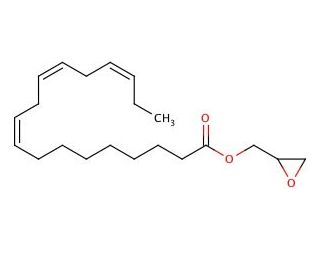

Glycidyl linolenate (CAS 51554-07-5)
QUICK LINKS
Glycidyl linolenate is an inhibitor of monoacylglycerol lipase and fatty acid amide hydrolase. As an organic compound it possesses valuable characteristics such as the colorless, viscous liquid emits a slightly acidic scent accompanied by a sweet and burning aroma. Due to its high reactivity, glycidyl finds extensive applications in synthesizing polymers, and various organic compounds. Additionally, it serves as a surfactant, plasticizer, and corrosion inhibitor in numerous industrial sectors. Furthermore, it has aided in studying the mechanisms of action of drugs and bioactive substances. Its usage extends to the examination of surfactants and other materials used in industrial settings. When combined with other compounds, it readily forms ethers, esters, and other derivatives. Additionally, it can engage in polymerization reactions, facilitating the creation of polymers with tailored characteristics. Moreover, glycidyl has the ability to form hydrogen bonds with other compounds, leading to alterations in the properties of the resulting substances.
Glycidyl linolenate (CAS 51554-07-5) References
- Direct Determination of MCPD Fatty Acid Esters and Glycidyl Fatty Acid Esters in Vegetable Oils by LC-TOFMS. | Haines, TD., et al. 2011. J Am Oil Chem Soc. 88: 1-14. PMID: 21350591
- Direct Determination of Glycidyl Esters of Fatty Acids in Vegetable Oils by LC-MS. | Blumhorst, MR., et al. 2011. J Am Oil Chem Soc. 88: 1275-1283. PMID: 21909156
- Determination of seven glycidyl esters in edible oils by gel permeation chromatography extraction and liquid chromatography coupled to mass spectrometry detection. | Dubois, M., et al. 2011. J Agric Food Chem. 59: 12291-301. PMID: 22017647
- Application of gastrointestinal modelling to the study of the digestion and transformation of dietary glycidyl esters. | Frank, N., et al. 2013. Food Addit Contam Part A Chem Anal Control Expo Risk Assess. 30: 69-79. PMID: 23083414
- Effect of chloride on the formation of 3-monochloro-1,2-propanediol fatty acid diesters and glycidol fatty acid esters in fish, meats and acylglycerols during heating. | Inagaki, R., et al. 2019. Food Addit Contam Part A Chem Anal Control Expo Risk Assess. 36: 236-243. PMID: 30652962
- Development of UHPLC/Q-TOF Analysis Method to Screen Glycerin for Direct Detection of Process Contaminants 3-Monochloropropane-1,2-diol Esters (3-MCPDEs) and Glycidyl Esters (GEs). | Girard, L., et al. 2021. Molecules. 26: PMID: 33922286
- Occurrence of glycidyl esters in infant formula products on the Canadian market between 2015 and 2019. | Schneider, JF., et al. 2023. Food Addit Contam Part A Chem Anal Control Expo Risk Assess. 40: 43-55. PMID: 36369749
- Simultaneous Determination of 2- and 3-Monochloropropan-1,3-diol Esters in Foods by Enzymatic Hydrolysis and GC–MS Detection | Stephen W. C. Chung & Benny T. P. Chan. 2012. Chromatographia. 75: 1049–1056.
- 4 - Direct Detection Techniques for Glycidyl Esters | Alice Thürer, Michael Granvogl. 2014. Processing Contaminants in Edible Oils. 91-120.
- Direct analytical detection methods for the food-borne toxicants glycidyl esters | Alice Ewert a, Michael Granvogl b c. 2022. Processing Contaminants in Edible Oils (Second Edition). 109-144.
Ordering Information
| Product Name | Catalog # | UNIT | Price | Qty | FAVORITES | |
Glycidyl linolenate, 50 mg | sc-394405 | 50 mg | $320.00 |