
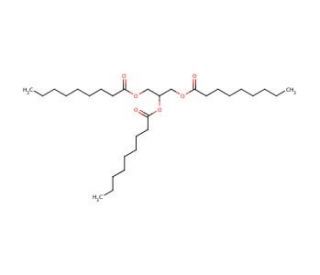

Glyceryl trinonanoate (CAS 126-53-4)
QUICK LINKS
Glyceryl trinonanoate, a triester of glycerol and nonanoic acid, has garnered attention in scientific research for its multifaceted applications across various fields. Its chemical structure lends itself to studies in lipid chemistry and biochemistry, where researchers have investigated its role as a model compound for understanding enzymatic reactions involved in triglyceride metabolism and lipid synthesis pathways. Specifically, glyceryl trinonanoate has been utilized as a substrate in enzymatic assays to explain the activity and specificity of lipases and esterases, providing insights into the molecular mechanisms underlying lipid digestion and hydrolysis processes. Moreover, its amphiphilic nature enables its incorporation into emulsions and lipid-based formulations, facilitating the encapsulation and delivery of hydrophobic compounds in pharmaceutical and food science research. In addition to its applications in lipid metabolism and delivery systems, glyceryl trinonanoate has found utility in materials science, where it contributes to the synthesis of biodegradable polymers and the fabrication of nanostructured materials with tunable properties. Through ongoing research efforts, glyceryl trinonanoate continues to unveil its potential as a versatile compound with diverse research applications, driving innovation and contributing to advancements in fields such as enzymology, lipid chemistry, materials science, and nanotechnology.
Glyceryl trinonanoate (CAS 126-53-4) References
- Flavor production from edible oils and their constituents by Penicillium corylophilum. | Fujikawa, H., et al. 2002. Shokuhin Eiseigaku Zasshi. 43: 160-4. PMID: 12238154
- Blood D-(-)-3-hydroxybutyrate concentrations after oral administration of trioctanoin, trinonanoin, or tridecanoin to newborn rhesus monkeys (Macaca mulatta). | Tetrick, MA., et al. 2010. Comp Med. 60: 486-90. PMID: 21262136
- The effects of intravenous infusions of triglycerides on the composition of milk fat in the sow. | Witter, RC., et al. 1970. Br J Nutr. 24: 269-78. PMID: 5463762
- Effect of long chain triglyceride on chylous transport of medium chain fatty acids. | Lee, DS., et al. 1968. Am J Physiol. 214: 294-9. PMID: 5635872
- The effects of intravenous infusions of triglycerides on the secretion of milk fat in the cow. | Storry, JE., et al. 1969. Br J Nutr. 23: 157-72. PMID: 5812864
- Enrichment of depot fat with odd and even numbered medium chain fatty acids. | Zurier, RB., et al. 1967. Am J Physiol. 212: 291-4. PMID: 6018009
- Effect of diets high in carbohydrate, soy oil, medium-chain triglycerides or tripelargonin on blood and liver lipid and glucose intermediates in meal-eating rats. | Guy, DG. and Tuley, RJ. 1981. J Nutr. 111: 1437-45. PMID: 7196442
- Organ changes after intravenous trinonanoin administration in rabbits. | Linseisen, J. and Wolfram, G. 1993. Ann Nutr Metab. 37: 328-34. PMID: 8109892
- Odd-numbered medium-chain triglycerides (trinonanoin) in total parenteral nutrition: effects on parameters of fat metabolism in rabbits. | Linseisen, J. and Wolfram, G. 1993. JPEN J Parenter Enteral Nutr. 17: 522-8. PMID: 8301805
- Efficacy of different triglycerides in total parenteral nutrition for preventing atrophy of the gut in traumatized rats. | Linseisen, J. and Wolfram, G. 1997. JPEN J Parenter Enteral Nutr. 21: 21-6. PMID: 9002080
Ordering Information
| Product Name | Catalog # | UNIT | Price | Qty | FAVORITES | |
Glyceryl trinonanoate, 5 ml | sc-211564 | 5 ml | $160.00 |