
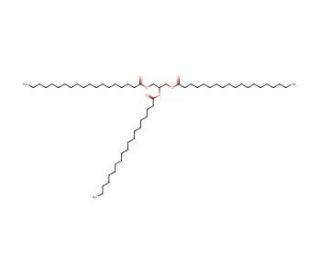

Glyceryl trinonadecanoate (CAS 26536-13-0)
QUICK LINKS
Glyceryl trinonadecanoate, a triglyceride composed of glycerol esterified with three nonadecanoic acid chains, stands out in the realm of lipid research due to its distinctive structural properties. Each nonadecanoic acid chain contains 19 carbon atoms, positioning this compound within the category of long-chain fatty acids, which are known for their solid-state stability and higher melting points. This triglyceride is extensively used in various research fields to study the thermal and physical behavior of lipids, particularly in understanding how the length and saturation of fatty acids influence lipid characteristics such as phase transitions, crystallization kinetics, and thermal stability. These properties make glyceryl trinonadecanoate a valuable model compound in materials science, where it helps in the development of sustainable, lipid-based materials like biodegradable plastics and environmentally friendly lubricants. Additionally, it serves an important role in the food industry research, where scientists explore its potential to affect the texture and stability of food products by manipulating lipid interactions. The ability of glyceryl trinonadecanoate to form stable structures at varying temperatures also provides insights into lipid packing and its implications for the structural organization within non-biological systems.
Glyceryl trinonadecanoate (CAS 26536-13-0) References
- Carotenoid and fatty acid metabolism in light-stressed Dunaliella salina. | Lamers, PP., et al. 2010. Biotechnol Bioeng. 106: 638-48. PMID: 20229508
- Functional analysis of three type-2 DGAT homologue genes for triacylglycerol production in the green microalga Chlamydomonas reinhardtii. | La Russa, M., et al. 2012. J Biotechnol. 162: 13-20. PMID: 22542934
- An optimized method for measuring fatty acids and cholesterol in stable isotope-labeled cells. | Argus, JP., et al. 2017. J Lipid Res. 58: 460-468. PMID: 27974366
- Sweep Jet Collection Laser-Induced Acoustic Desorption Atmospheric Pressure Photoionization for Lipid Analysis Applications. | Benham, K., et al. 2019. J Am Soc Mass Spectrom. 30: 647-658. PMID: 30617859
- Study of in vitro interaction between Fusarium verticillioides and Streptomyces sp. using metabolomics. | Nguyen, PA., et al. 2020. Folia Microbiol (Praha). 65: 303-314. PMID: 31250362
- A Novel GC-FID Analytical Strategy Reveals Adulteration of Fuels by Vegetable Oil. | Francescangeli, A., et al. 2020. J AOAC Int. 103: 449-455. PMID: 31533873
- Enhanced triacylglycerol production in oleaginous microalga Neochloris oleoabundans by co-overexpression of lipogenic genes: Plastidial LPAAT1 and ER-located DGAT2. | Chungjatupornchai, W. and Fa-Aroonsawat, S. 2021. J Biosci Bioeng. 131: 124-130. PMID: 33069576
- CAR Protects Females from Diet-Induced Steatosis and Associated Metabolic Disorders. | Oliviero, F., et al. 2023. Cells. 12: PMID: 37759441
- HPLC method for separation of cannabidiol hemp seed oil with skin lipids and tandem HRMS technology for characterization of a chemical marker[J]. | Liu Y, Wang Y, Hao Z,. 2021. Cosmetics,. 8(4): 108.
- Strategies for an improved extraction and separation of lipids and carotenoids from oleaginous yeast[J]. | Liu Z, van den Berg C, Weusthuis R A,. 2021. Separation and Purification Technology,. 257: 117946.
Ordering Information
| Product Name | Catalog # | UNIT | Price | Qty | FAVORITES | |
Glyceryl trinonadecanoate, 100 mg | sc-215090 | 100 mg | $270.00 | |||
Glyceryl trinonadecanoate, 1 g | sc-215090A | 1 g | $709.00 |