
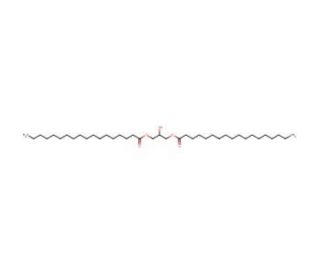

Glyceryl 1,3-distearate (CAS 504-40-5)
QUICK LINKS
Glyceryl 1,3-distearate, or known as glyceryl distearate, is a solid white wax that exudes a delicate aroma and possesses a melting point of approximately 55°C. This compound is a glycerol ester derived from stearic acid. Its multifunctional properties make it a valuable ingredient in various industries. Specifically, glyceryl 1,3-distearate finds application as an emulsifier, thickener, and lubricant. Furthermore, it serves as a fundamental building block for synthesizing a diverse range of compounds such as surfactants, polymers, and polyols. Numerous scientific research investigations have explored the properties of glyceryl 1,3-distearate across various applications. Its involvement in the examination of surfactant physical characteristics, polymer structures, and polyol synthesis has been documented. Additionally, it has been instrumental in studying emulsion properties, lipid structures, and the mechanisms of action of pharmaceuticals. As an emulsifier, glyceryl 1,3-distearate plays a role in maintaining the stability of mixtures containing immiscible liquids, such as oil and water. It accomplishes this by enveloping the molecules of each liquid, preventing them from separating and coming into direct contact with one another. Moreover, its thickening properties contribute to the stability of the mixture, ensuring its consistency and homogeneity.
Glyceryl 1,3-distearate (CAS 504-40-5) References
- Structural characterization of triacylglycerols as lithiated adducts by electrospray ionization mass spectrometry using low-energy collisionally activated dissociation on a triple stage quadrupole instrument. | Hsu, FF. and Turk, J. 1999. J Am Soc Mass Spectrom. 10: 587-99. PMID: 10384723
- Electrospray ionization multiple-stage linear ion-trap mass spectrometry for structural elucidation of triacylglycerols: assignment of fatty acyl groups on the glycerol backbone and location of double bonds. | Hsu, FF. and Turk, J. 2010. J Am Soc Mass Spectrom. 21: 657-69. PMID: 20171120
- Triacylglyceride measurement in small quantities of homogenised insect tissue: comparisons and caveats. | Williams, CM., et al. 2011. J Insect Physiol. 57: 1602-13. PMID: 21878339
- Modified Gas Chromatographic Method to Determine Monoacylglycerol and Diacylglycerol Contents in Edible Fats and Oils. | Satou, C., et al. 2017. J Oleo Sci. 66: 601-606. PMID: 28515375
- Selective and fast methylation of free fatty acids directly in plasma for their individual analysis by gas chromatography- mass spectrometry. | Ciucanu, CI., et al. 2020. J Chromatogr A. 1624: 461259. PMID: 32540084
- The thermal, rheological, and structural characterization of grapeseed oil oleogels structured with binary blends of oleogelator. | Choi, KO., et al. 2020. J Food Sci. 85: 3432-3441. PMID: 32918281
- The Effects of Solid and Liquid Lipids on the Physicochemical Properties of Nanostructured Lipid Carriers. | Apostolou, M., et al. 2021. J Pharm Sci. 110: 2859-2872. PMID: 33901564
- Solid-liquid equilibrium of free form of oil contaminants (3-MCPD and glycidol) in lipidic systems. | Andrade, SS., et al. 2022. Food Res Int. 160: 111740. PMID: 36076422
Ordering Information
| Product Name | Catalog # | UNIT | Price | Qty | FAVORITES | |
Glyceryl 1,3-distearate, 10 mg | sc-215081 | 10 mg | $32.00 | |||
Glyceryl 1,3-distearate, 100 mg | sc-215081A | 100 mg | $128.00 |