
Plasmide CRISPR/Cas9 KO Glucagon Receptor (m2): sc-420508-KO-2
- Espèces cibles: mouse
- 20 µg d'ADN plasmidique purifié et prêt à transfecter; Jusqu'à 20 transfections
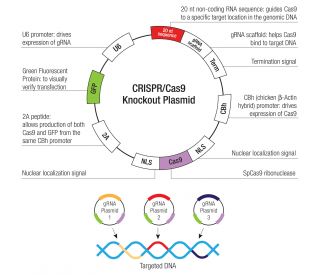
- Glucagon Receptor Le plasmide CRISPR/Cas9 Knockout (KO) (m2) est un ensemble de plasmides, chacun codant pour la nucléase Cas9 et un ARN guide (gRNA) de 20 nt spécifique à la cible, conçu pour une efficacité de knockout maximale à l'aide de séquences issues de la bibliothèque GeCKO v2
- Les séquences d'ARN guide (gRNA) dirigent Cas9 pour induire des cassures double brin (DSB) spécifiques au site dans le locus génomique Glucagon Receptor, entraînant un knock-out génique par jonction non homologue (NHEJ)
- Le plasmide HDR Glucagon Receptor (m2) (sc-420508-HDR-2) est recommandé pour une co-transfection avec le plasmide CRISPR/Cas9 KO Glucagon Receptor (m2) afin de permettre la sélection des cellules éditées avec succès grâce à l'intégration, médiée par HDR, d'un cassette de résistance à la puromycine et d'un gène rapporteur RFP
- Le plasmide HDR Glucagon Receptor (m2) est un ensemble de plasmides, chacun contenant un matrice de réparation dirigée par homologie (HDR) correspondant aux sites cibles de l'ARN guide (gRNA) dans le plasmide CRISPR/Cas9 KO Glucagon Receptor (m2)
- Chaque plasmide HDR contient deux bras d'homologie d'environ 800 pb flanquant les cassettes de résistance à la puromycine et RFP, conçus pour se lier aux séquences d'ADN génomique entourant le site de cassure double brin induit par Cas9 et faciliter une intégration précise médiée par HDR
- Les gènes de résistance à la puromycine et RFP sont flanqués de sites LoxP, permettant la suppression des marqueurs de sélection via la recombinase Cre (Cre Vector : sc-418923) après l'établissement de lignées cellulaires knock-out stables

Informations pour la commande
| Nom du produit | Ref. Catalogue | COND. | Prix HT | QTÉ | Favoris | |
Plasmide CRISPR/Cas9 KO Glucagon Receptor (m2) | sc-420508-KO-2 | 20 µg | $397.00 | |||
Plasmid HDR Glucagon Receptor (m2) | sc-420508-HDR-2 | 20 µg | $445.00 |
Présentation
Le gène murin *Gcgr* code le récepteur du glucagon (GCGR), un récepteur couplé aux protéines G de classe B qui assure la signalisation du glucagon afin de réguler la production hépatique de glucose et l’homéostasie énergétique de l’organisme. Après liaison du ligand, GCGR se couple principalement à Gαs pour stimuler l’adénylate cyclase, augmenter l’AMPc et activer des programmes transcriptionnels dépendants de PKA/CREB qui favorisent la glycogénolyse et la néoglucogenèse ; il peut également mobiliser d’autres nœuds de signalisation influençant le métabolisme lipidique. L’activité de GCGR intègre les signaux endocriniens pendant le jeûne et le stress et façonne les flux métaboliques dans le foie et d’autres tissus répondeurs. La dérégulation de la signalisation glucagon–GCGR est étroitement associée à des phénotypes métaboliques pertinents pour le diabète et des troubles apparentés, faisant de *Gcgr* une cible clé pour des études mécanistiques des voies du glucose et des lipides.
Le Glucagon Receptor CRISPR/Cas9 KO Plasmid (m2) est un ensemble de plasmides conçus pour la disruption ciblée du gène Gcgr dans les lignées cellulaires mouse. Chaque plasmide du pool co-exprime un sgRNA unique, ciblant un site distinct au sein du locus Gcgr, ainsi que la nucléase Cas9 de Streptococcus pyogenes, et code pour la GFP afin de permettre l'identification par fluorescence et l'enrichissement des cellules transfectées avec succès. Cette stratégie multi-guide augmente la probabilité d'induire des décalages de cadre ou des délétions produisant un knock-out fonctionnel, offrant ainsi une alternative plus robuste aux approches à guide unique. Les cassures double brin (DSB) induites à plusieurs sites sont résolues par jonction non homologue (NHEJ) ou, lorsqu'elles sont utilisées avec le modèle donneur HDR inclus, par réparation dirigée par homologie (HDR) à un site cible défini au sein du locus.
Lorsqu'il est utilisé en conjonction avec le donneur HDR exprimant la RFP, les fluorescences GFP et RFP peuvent être utilisées conjointement pour distinguer les populations de cellules transfectées de celles éditées, rationalisant ainsi les workflows de tri par cytométrie en flux et de sélection de clones.
Donneur de réparation dirigée par homologie (HDR) — Cassette de puromycine avec rapporteur RFP
Pour les applications nécessitant des clones knock-out confirmés et sélectionnables, le Glucagon Receptor plasmide HDR (m2) comprend une construction donneuse HDR contenant une cassette de résistance à la puromycine (PuroR) et un rapporteur protéine fluorescente rouge (RFP), flanquée de bras d'homologie spécifiques à un site cible Gcgr défini.
Lorsqu'il est co-transfecté avec le plasmide Glucagon Receptor CRISPR/Cas9 KO (m2):
- La cassette PuroR-RFP s'intègre au site de coupure de Cas9 via HDR, perturbant le cadre de lecture ouvert Gcgr.
La fluorescence RFP fournit un indicateur visuel immédiat de la réussite de l'intégration, permettant l'identification ou le tri par fluorescence des cellules éditées avant ou parallèlement à la sélection par la puromycine.
Les cellules éditées avec succès sont confirmées par leur résistance à la puromycine, ce qui réduit considérablement la charge de criblage des clones.
Cette stratégie de sélection est idéale pour générer des lignées cellulaires KO clonales stables destinées à des études fonctionnelles en aval, au criblage de médicaments ou au développement de modèles.
Système de suppression de la cassette Cre-lox
La construction donneuse HDR comporte des sites loxP flanquant la cassette de sélection PuroR-RFP afin de permettre une suppression propre du marqueur après confirmation du clone. L'expression transitoire de la recombinase Cre via le vecteur Cre inclus Cre Vector: sc-418923 excise la cassette, laissant un site loxP résiduel minimal au sein du locus Gcgr et éliminant les effets de confusion potentiels sur les tests en aval.
Cette approche en deux étapes :
- Minimise la perturbation de l'architecture locale de la chromatine et des éléments régulateurs voisins
Restaure un contexte génomique quasi-naturel au niveau du locus édité
Permet la réutilisation de la stratégie de sélection à la puromycine dans la même lignée cellulaire pour des modifications supplémentaires
Caractéristiques principales
- gRNA ciblant le ou les exons Gcgr essentiels à la fonction Glucagon Receptor
Co-expression de SpCas9 et de sgRNA à partir d'un seul plasmide pour une administration simplifiée
Donneur HDR avec résistance à la puromycine pour une sélection positive des clones
Cassette PuroR flanquée de loxP avec vecteur de recombinase Cre pour une suppression transparente du marqueur
Fourni prêt à l'emploi pour une administration par transfection
Réservé à la recherche. N'est pas destiné à un usage diagnostique ou thérapeutique.