
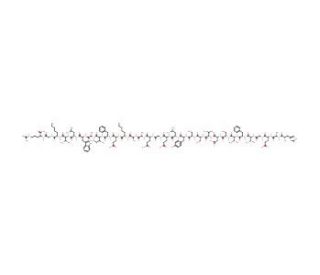

Glucagon-Like Peptide 1 (7-36) Amide (CAS 107444-51-9)
QUICK LINKS
Glucagon-Like Peptide 1 (GLP-1) (7-36) Amide, a peptide hormone produced in the intestine and released in response to food intake, has emerged as a key player in scientific research, particularly within the fields of endocrinology, metabolism, and diabetes. Upon secretion, GLP-1 (7-36) amide binds to GLP-1 receptors located on pancreatic β-cells, resulting in the activation of adenylate cyclase and subsequent elevation of intracellular cyclic adenosine monophosphate (cAMP) levels. This signaling cascade leads to enhanced insulin secretion and synthesis, as well as inhibition of glucagon release, thereby promoting glucose-dependent insulin secretion and lowering blood glucose levels. Additionally, GLP-1 (7-36) amide exerts extrapancreatic effects, including slowing gastric emptying, reducing appetite, and promoting satiety, which contribute to its metabolic benefits. Research utilizing GLP-1 (7-36) amide and its analogs has provided insights into its mechanisms of action and its potential applications for type 2 diabetes mellitus, obesity, and metabolic syndrome. Furthermore, GLP-1 (7-36) amide has been studied for its neuroprotective effects and its implications in neurodegenerative diseases, highlighting its multifaceted roles in metabolic regulation and beyond.
Glucagon-Like Peptide 1 (7-36) Amide (CAS 107444-51-9) References
- Glucagon-like peptide-1 (7-36) amide as a novel neuropeptide. | Blázquez, E., et al. 1998. Mol Neurobiol. 18: 157-73. PMID: 10065878
- Glucagon-like peptide-1 (7-36) amide: a central regulator of satiety and interoceptive stress. | van Dijk, G. and Thiele, TE. 1999. Neuropeptides. 33: 406-14. PMID: 10657518
- The structure and function of the glucagon-like peptide-1 receptor and its ligands. | Donnelly, D. 2012. Br J Pharmacol. 166: 27-41. PMID: 21950636
- Impact of glucagon-like peptide-1 (7-36) amide, isosteviol and 5-aminoimidazole-4-carboxamide 1-β-d-ribofuranoside on leucine-mediated α-cell dysfunction. | Chen, X., et al. 2012. Diabetes Obes Metab. 14: 1020-31. PMID: 22747908
- Internalization of glucagon-like peptide-1(7-36)amide in rat insulinoma cells. | Göke, R., et al. 1989. Res Exp Med (Berl). 189: 257-64. PMID: 2554438
- Glucagon-Like Peptide-1: A Promising Agent for Cardioprotection During Myocardial Ischemia. | Giblett, JP., et al. 2016. JACC Basic Transl Sci. 1: 267-276. PMID: 30167515
- Glucagon-like peptide-1 (7-36 amide): a potent glucagonostatic and insulinotropic hormone. | Matsuyama, T., et al. 1988. Diabetes Res Clin Pract. 5: 281-4. PMID: 3069410
- Development of drug alone and carrier-based GLP-1 dry powder inhaler formulations. | Babenko, M., et al. 2022. Int J Pharm. 617: 121601. PMID: 35181460
- Receptor-associated independent cAMP nanodomains mediate spatiotemporal specificity of GPCR signaling. | Anton, SE., et al. 2022. Cell. 185: 1130-1142.e11. PMID: 35294858
- Substance P and Glucagon-like Peptide-17-36 Amide Mediate Anorexic Responses to Trichothecene Deoxynivalenol and Its Congeners. | Jia, H., et al. 2022. Toxins (Basel). 14: PMID: 36548782
Ordering Information
| Product Name | Catalog # | UNIT | Price | Qty | FAVORITES | |
Glucagon-Like Peptide 1 (7-36) Amide, 1 mg | sc-391162 | 1 mg | $376.00 |