
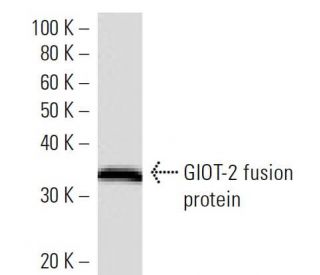

GIOT-2 Antibody (3421C3a): sc-81143
- GIOT-2 Antibody (3421C3a) is a mouse monoclonal IgG1 provided at 100 µg/ml
- raised against a recombinant protein corresponding to an internal region of GIOT-2 of human origin
- recommended for detection of GIOT-2 of human origin by WB and IP
- At present, we have not yet completed the identification of the preferred secondary detection reagent(s) for GIOT-2 Antibody (3421C3a). This work is in progress.

GIOT-2 Antibody (3421C3a) is a mouse monoclonal IgG1 antibody that detects GIOT-2 in human samples through applications such as western blotting (WB) and immunoprecipitation (IP). GIOT-2, also known as Gonadotropin-inducible transcription repressor 2 or ZNF44, is a 589 amino acid protein belonging to the Krüppel C2H2-type zinc-finger family, characterized by its 16 C2H2-type zinc fingers and a single KRAB domain. This nuclear protein plays a crucial role in transcriptional regulation, particularly in the repression of gonadotropin gene expression, which is vital for maintaining proper reproductive function and hormonal balance. The presence of the KRAB domain is significant as KRAB interacts with KAP1, facilitating the recruitment of histone-modifying proteins that can alter chromatin structure and influence gene expression. Anti-GIOT-2 antibody (3421C3a) enables researchers to gain insights into the regulatory mechanisms of gonadotropin expression and the broader implications for reproductive health and endocrine signaling.
Alexa Fluor® is a trademark of Molecular Probes Inc., OR., USA
LI-COR® and Odyssey® are registered trademarks of LI-COR Biosciences
GIOT-2 Antibody (3421C3a) References:
- Genetic signatures of differentiation induced by 1alpha,25-dihydroxyvitamin D3 in human colon cancer cells. | Pálmer, HG., et al. 2003. Cancer Res. 63: 7799-806. PMID: 14633706
- Discrimination of vanadium from zinc using gene profiling in human bronchial epithelial cells. | Li, Z., et al. 2005. Environ Health Perspect. 113: 1747-54. PMID: 16330358
- Chemopreventive agents alters global gene expression pattern: predicting their mode of action and targets. | Narayanan, BA. 2006. Curr Cancer Drug Targets. 6: 711-27. PMID: 17168675
- Characterization and mapping of human genes encoding zinc finger proteins. | Bray, P., et al. 1991. Proc Natl Acad Sci U S A. 88: 9563-7. PMID: 1946370
- Use of integrative epigenetic and cytogenetic analyses to identify novel tumor-suppressor genes in malignant melanoma. | Mithani, SK., et al. 2011. Melanoma Res. 21: 298-307. PMID: 21606880
- Deletions of 16p11.2 and 19p13.2 in a family with intellectual disability and generalized epilepsy. | Bassuk, AG., et al. 2013. Am J Med Genet A. 161A: 1722-5. PMID: 23686817
- Myoepithelioma of bone with a novel FUS-POU5F1 fusion gene. | Puls, F., et al. 2014. Histopathology. 65: 917-22. PMID: 25066216
- Somatic mutations in specific and connected subpathways are associated with short neuroblastoma patients' survival and indicate proteins targetable at onset of disease. | Esposito, MR., et al. 2018. Int J Cancer. 143: 2525-2536. PMID: 29992558
- RNA-Sequencing Combined With Genome-Wide Allele-Specific Expression Patterning Identifies ZNF44 Variants as a Potential New Driver Gene for Pediatric Neuroblastoma. | Sun, L., et al. 2023. Cancer Control. 30: 10732748231175017. PMID: 37161925
- An interaction between the DNA-binding domains of RelA(p65) and Sp1 mediates human immunodeficiency virus gene activation. | Perkins, ND., et al. 1994. Mol Cell Biol. 14: 6570-83. PMID: 7935378
Ordering Information
| Product Name | Catalog # | UNIT | Price | Qty | FAVORITES | |
GIOT-2 Antibody (3421C3a) | sc-81143 | 100 µg/ml | $339.00 |