
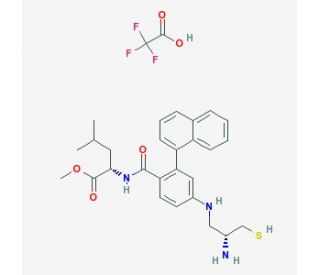

GGTI 298 的分子结构, CAS编号: 1217457-86-7
GGTI 298 (CAS 1217457-86-7)
查看产品引用文献(2)
备用名:
N-[[4-(2-(R)-Amino-3-mercaptopropyl)amino]-2-naphthylbenzoyl]leucine methyl ester trifluoroacetate salt
应用:
GGTI 298 是一种 CAAZ 拟肽 GGT 酶 I 抑制剂
CAS号码:
1217457-86-7
纯度:
≥95%
分子量:
593.66
分子式:
C27H33N3O3S•CF3CO2H
仅供科研使用。不可用于诊断或治疗。
* 参考分析证明 大量特定数据 (包括水 含量).
快捷链接
订购信息
产品相关文献索引
描述
技术信息
安全信息
安全技术说明书和分析证明书
GGTI 298已被证明是一种CAAZ肽模拟GGTase I(geranylgeranyltransferase I)抑制剂。这种化合物已被证明能导致A549细胞G0-G1细胞周期阻滞和凋亡。GGTI 298已证明对GSK3具有强效抑制作用,IC50为0.2 µM,对其他蛋白激酶表现出高度选择性。它已被广泛应用于各种体外研究,包括细胞增殖、凋亡和细胞迁移等细胞基实验。此外,GGTI298已被用于涉及酶活性、蛋白质-蛋白质相互作用和DNA-蛋白质相互作用的生化测定,展示了其在研究环境中的多样性和实用性。
GGTI 298 (CAS 1217457-86-7) 参考文献
- 香叶木基转移酶 I 抑制剂 GGTI-298 可诱导视网膜母细胞瘤的低磷酸化和细胞周期蛋白依赖性激酶抑制剂的伙伴转换。GGTI-298抗肿瘤活性的潜在机制。 | Sun, J., et al. 1999. J Biol Chem. 274: 6930-4. PMID: 10066746
- 破骨细胞的形成, 功能和存活都离不开姜氨酰鸟苷酸蛋白:双磷酸盐和 GGTI-298 的抑制作用。 | Coxon, FP., et al. 2000. J Bone Miner Res. 15: 1467-76. PMID: 10934645
- 法尼基化的 RhoB 可防止由客草基转移酶 I 抑制剂 GGTI-298 引起的细胞周期停滞和肌动蛋白细胞骨架破坏。 | Allal, C., et al. 2002. Cell Cycle. 1: 430-7. PMID: 12548020
- 鹿角酰转移酶 I 抑制剂对癌细胞侵袭的选择性抑制。 | Kusama, T., et al. 2003. Clin Exp Metastasis. 20: 561-7. PMID: 14598891
- 磷脂酰肌醇-3-OH 激酶/AKT 和存活素途径是香叶基转移酶 I 抑制剂诱导细胞凋亡的关键靶点。 | Dan, HC., et al. 2004. Oncogene. 23: 706-15. PMID: 14737105
- 以酵母为基础的基因组策略凸显了被FT酶阻抑剂拟肽物改变的细胞蛋白质网络。 | Porcu, G., et al. 2010. Mol Cancer. 9: 197. PMID: 20653956
- 他汀类药物诱导的内皮保护基因被 FTI-277 和 GGTI-298 组合药物引发的 ERK5 激活所模拟。 | Chu, UB., et al. 2015. Biochim Biophys Acta. 1850: 1415-25. PMID: 25829196
- 香叶基吉兰转移酶 1 抑制剂 GGTI-298 可增强吉非替尼的抗癌效果。 | Liu, BS., et al. 2018. Mol Med Rep. 18: 4023-4029. PMID: 30106149
- 血小板衍生物生长因子受体酪氨酸磷酸化需要蛋白质的geranylgeranylation,但不需要farnesylation。 | McGuire, TF., et al. 1996. J Biol Chem. 271: 27402-7. PMID: 8910319
- 小鼠成纤维细胞从 G1 期向 S 期转变所需的蛋白是香叶基巨氨酰化,而不是法尼酰化。 | Vogt, A., et al. 1996. Oncogene. 13: 1991-9. PMID: 8934546
- GGTI-298 可诱导 A549 细胞发生 G0-G1 阻塞和凋亡,而 FTI-277 则会导致 G2-M 富集。 | Miquel, K., et al. 1997. Cancer Res. 57: 1846-50. PMID: 9157972
- 香叶基转移酶-I抑制剂GGTI-298能使人类肿瘤细胞停滞在G0/G1期,并以与p53无关的方式诱导p21(WAF1/CIP1/SDI1)。 | Vogt, A., et al. 1997. J Biol Chem. 272: 27224-9. PMID: 9341167
- 将抑制 Ras 和相关 G 蛋白作为阻止恶性胶质瘤生长的治疗策略。 | Bredel, M., et al. 1998. Neurosurgery. 43: 124-31; discussion 131-2. PMID: 9657198
抑制剂:
ARHGAP11B, ARHGAP15, C8orf80, Cntnap5c, CRB3, DSCR 5, Ect2, EG331493, EG432798, Enzyme, FTβ, GGPS1 (geranylgeranyl diphosphate synthase 1), GGTase, GGtase-α, GGTase-Iα, GTPBP6, Lamin A, Lamin A/C, LARG, Malcavernin, MVD, PCYOX1L, PIG-V, PIG-Z, PLEKHG1, PMVK, R-ras3, Rab 1B, Rab 2A, Rab 30, Rab 35, Rab GTPase (RAB; RAS oncogene), Rab L3, Rab40B, RABAPTIN-5, Ral GDS, RAP, RASA4, RASL11A, RCE1, REP-2, Repac, RGL4, RIN1, RSU1, TBC1D13, TBC1D2, TBC1D2B, TC 21, TERE1, TGN38B, XG FTase, 和 ZDHHC12.激活剂:
ACTR-IC, ARHGEF38, ARL15, ARL4D, CMV gH, FAM18A, GGtase-α, GGTase-Iα, GP73, GTPBP5, GTPBP6, H-Ras, NKHC1, PIG-Q, PRK1, R-Ras, RAM, Rap 1A, Rho GAP p190, Rho GAP p190-B, Rhotekin, 和 TES.订购信息
| 产品名称 | 产品编号 | 规格 | 价格 | 数量 | 收藏夹 | |
GGTI 298, 1 mg | sc-361184 | 1 mg | $193.00 | |||
GGTI 298, 5 mg | sc-361184A | 5 mg | $838.00 |