
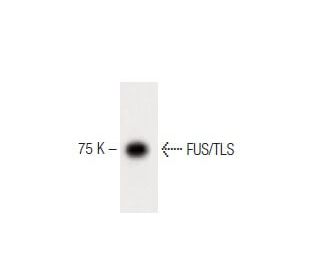

FUS/TLS Antibody (15): sc-135911
- FUS/TLS Antibody (15) is a mouse monoclonal IgG1, cited in 2 publications, provided at 50 µg/0.5 ml
- raised against amino acids 2-117 of FUS/TLS of human origin
- recommended for detection of FUS/TLS of mouse, rat and human origin by WB, IP and IF
- See FUS/TLS (4H11): sc-47711 for FUS/TLS antibody conjugates, including AC, HRP, FITC, PE, Alexa Fluor® 488, 594, 647, 680 and 790.
- At present, we have not yet completed the identification of the preferred secondary detection reagent(s) for FUS/TLS Antibody (15). This work is in progress.

QUICK LINKS
SEE ALSO...
FUS/TLS Antibody (15) is a mouse monoclonal IgG1 antibody that detects FUS/TLS in mouse, rat, and human samples through applications such as western blotting (WB), immunoprecipitation (IP), and immunofluorescence (IF). FUS/TLS is a crucial nuclear RNA-binding protein that plays a significant role in the regulation of gene expression and RNA processing. FUS/TLS (15) antibody can help detect interactions with various nuclear steroid receptors, suggesting FUS/TLS involvement in the transcriptional response to hormonal signals, which is vital for maintaining cellular homeostasis and responding to environmental changes. Additionally, anti-FUS/TLS antibody (15) can identify FUS/TLS as part of the TFIID complex, indicating involvement in the initiation of transcription and processing of primary transcripts. The dysregulation of FUS/TLS, often due to chromosomal translocations, can lead to oncogenic fusions that contribute to the development of certain cancers, such as myxoid liposarcomas and myeloid leukemias. FUS/TLS monoclonal antibody (15) enables researchers to gain insights into the functional dynamics of FUS/TLS and its implications in both normal physiology and disease states.
Alexa Fluor® is a trademark of Molecular Probes Inc., OR., USA
LI-COR® and Odyssey® are registered trademarks of LI-COR Biosciences
FUS/TLS Antibody (15) References:
- TDP-43 and FUS/TLS: emerging roles in RNA processing and neurodegeneration. | Lagier-Tourenne, C., et al. 2010. Hum Mol Genet. 19: R46-64. PMID: 20400460
- TDP-43 and FUS/TLS: cellular functions and implications for neurodegeneration. | Fiesel, FC. and Kahle, PJ. 2011. FEBS J. 278: 3550-68. PMID: 21777389
- Long noncoding RNAs in TDP-43 and FUS/TLS-related frontotemporal lobar degeneration (FTLD). | Lourenco, GF., et al. 2015. Neurobiol Dis. 82: 445-454. PMID: 26220395
- Physiological functions and pathobiology of TDP-43 and FUS/TLS proteins. | Ratti, A. and Buratti, E. 2016. J Neurochem. 138 Suppl 1: 95-111. PMID: 27015757
- FUS/TLS acts as an aggregation-dependent modifier of polyglutamine disease model mice. | Kino, Y., et al. 2016. Sci Rep. 6: 35236. PMID: 27739513
- FUS/TLS Suppresses Enterovirus Replication and Promotes Antiviral Innate Immune Responses. | Xue, YC., et al. 2021. J Virol. 95: PMID: 33827951
- Tertiary lymphoid structures (TLS) identification and density assessment on H&E-stained digital slides of lung cancer. | Barmpoutis, P., et al. 2021. PLoS One. 16: e0256907. PMID: 34555057
- FUS-mediated HypEVs: Neuroprotective effects against ischemic stroke. | Wu, Y., et al. 2023. Bioact Mater. 29: 196-213. PMID: 37621770
- Drosha-dependent microRNAs modulate FUS-mediated neurodegeneration in vivo. | Kour, S., et al. 2023. Nucleic Acids Res. 51: 11258-11276. PMID: 37791873
- FUS reads histone H3K36me3 to regulate alternative polyadenylation. | Jia, J., et al. 2024. Nucleic Acids Res. 52: 5549-5571. PMID: 38499486
Ordering Information
| Product Name | Catalog # | UNIT | Price | Qty | FAVORITES | |
FUS/TLS Antibody (15) | sc-135911 | 50 µg/0.5 ml | $322.00 |