
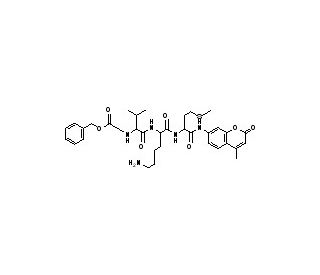

Fluorogenic Proteasome Substrate (CAS 141223-71-4)
QUICK LINKS
Fluorogenic Proteasome Substrate serves as a pivotal tool in scientific research, particularly within the domain of proteasome biology. This substrate is ingeniously engineered to undergo selective cleavage by the proteasome enzyme complex, leading to the liberation of a fluorescent signal that can be quantified and monitored in real-time. By harnessing the enzymatic activity of the proteasome, Fluorogenic Proteasome Substrate facilitates the exploration of proteasome kinetics and specificity in protein degradation processes. Its fluorogenic nature enables sensitive and dynamic detection of proteasome activity, offering insights into its regulation in various cellular contexts, including cell cycle progression, apoptosis, and stress responses. Furthermore, this substrate serves as a versatile tool for high-throughput screening of proteasome modulators, aiding in the discovery of potential agents for diseases characterized by proteasome dysfunction, such as cancer and neurodegenerative disorders. Additionally, Fluorogenic Proteasome Substrate has been instrumental in elucidating the molecular mechanisms underlying proteasome-mediated protein degradation, contributing to our understanding of fundamental cellular processes and paving the way for future research endeavors in proteasome biology.
Fluorogenic Proteasome Substrate (CAS 141223-71-4) References
- Thimet oligopeptidase cleaves the full-length Alzheimer amyloid precursor protein at a beta-secretase cleavage site in COS cells. | Koike, H., et al. 1999. J Biochem. 126: 235-42. PMID: 10393344
- Presence of angiotensin-converting enzyme in follicular fluids of porcine ovaries and its possible involvement in the intrafollicular breakdown of bradykinin. | Matsui, H. and Takahashi, T. 2002. Mol Reprod Dev. 62: 99-105. PMID: 11933166
- Beta-amyloid peptide in regulated secretory vesicles of chromaffin cells: evidence for multiple cysteine proteolytic activities in distinct pathways for beta-secretase activity in chromaffin vesicles. | Hook, VY., et al. 2002. J Neurochem. 81: 237-56. PMID: 12064471
- Inhibition of cathepsin B reduces beta-amyloid production in regulated secretory vesicles of neuronal chromaffin cells: evidence for cathepsin B as a candidate beta-secretase of Alzheimer's disease. | Hook, V., et al. 2005. Biol Chem. 386: 931-40. PMID: 16164418
- Inhibitors of cathepsin B improve memory and reduce beta-amyloid in transgenic Alzheimer disease mice expressing the wild-type, but not the Swedish mutant, beta-secretase site of the amyloid precursor protein. | Hook, VY., et al. 2008. J Biol Chem. 283: 7745-53. PMID: 18184658
- Cysteine Cathepsins in the secretory vesicle produce active peptides: Cathepsin L generates peptide neurotransmitters and cathepsin B produces beta-amyloid of Alzheimer's disease. | Hook, V., et al. 2012. Biochim Biophys Acta. 1824: 89-104. PMID: 21925292
- Distribution of Alzheimer's disease amyloid A4-generating enzymes in rat brain tissue. | Ishiura, S., et al. 1990. Neurosci Lett. 115: 329-34. PMID: 2234509
Ordering Information
| Product Name | Catalog # | UNIT | Price | Qty | FAVORITES | |
Fluorogenic Proteasome Substrate, 1 mg | sc-3129 | 1 mg | $100.00 |