
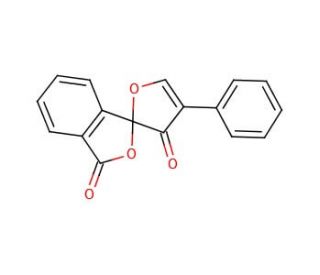

Fluorescamine (CAS 38183-12-9)
See product citations (1)
QUICK LINKS
Fluorescamine, a fluorescent dye, finds widespread use across various scientific fields due to its remarkable versatility and utility. Researchers have come to rely on this dye for a multitude of applications, ranging from investigating protein structure to assessing enzyme activity. In comparison to other fluorescent dyes, Fluorescamine boasts several advantages, including its low toxicity, high sensitivity, and wide range of uses. Within scientific research, Fluorescamine serves as useful, finding applications in protein and enzyme studies where it enables the measurement of enzyme activity and protein structure. Additionally, in the realm of cell biology, this dye proves indispensable for monitoring cellular metabolism and exploring the effects of drugs on cells. Notably, Fluorescamine′s role extends to drug discovery and development, facilitating investigations into the effects of drugs on proteins and enzymes. The functioning of Fluorescamine revolves around its ability to bind to proteins and enzymes, thereby causing alterations in their structure and activity. Furthermore, the dye is known for its affinity to DNA and RNA, making it an essential asset in the study of gene expression. Not to be outdone, Fluorescamine′s interactions with lipids and carbohydrates provide valuable insights into lipid and carbohydrate metabolism.
Fluorescamine (CAS 38183-12-9) References
- Application of fluorescamine to the study of protein-DNA interactions. | Bode, J. and Willmitzer,. 1975. Nucleic Acids Res. 2: 1951-65. PMID: 1237881
- Fluorescamine-induced membrane permeability in mitochondria. | Chávez, E., et al. 1992. Int J Biochem. 24: 1779-84. PMID: 1451913
- High-throughput profiling of nanoparticle-protein interactions by fluorescamine labeling. | Ashby, J., et al. 2015. Anal Chem. 87: 2213-9. PMID: 25587850
- Determination of cephalosporin-C amidohydrolase activity with fluorescamine. | Reyes, F., et al. 1989. J Pharm Pharmacol. 41: 136-7. PMID: 2568426
- The use of fluorescamine as a detection reagent in protein microcharacterization. | Miedel, MC., et al. 1989. J Biochem Biophys Methods. 18: 37-52. PMID: 2723330
- The convenient use of fluorescamine for spectrofluorimetric determination of midodrine hydrochloride in pure form and its tablets formulation: Application to content uniformity testing. | Omar, MA., et al. 2019. Luminescence. 34: 84-89. PMID: 30536965
- [Determination of Nonvolatile Amines in Foods by HPLC Following Fluorescamine Derivatization]. | Kubota, A., et al. 2019. Shokuhin Eiseigaku Zasshi. 60: 61-67. PMID: 31391412
- The convenient use of fluorescamine for spectrofluorimetric quantitation of pramipexole in pure form and pharmaceutical formulation; application to content uniformity testing. | Derayea, SM., et al. 2020. Spectrochim Acta A Mol Biomol Spectrosc. 238: 118414. PMID: 32413715
- Development of luminol-fluorescamine-PVP chemiluminescence system and its application to sensitive tyrosinase determination. | Wang, C., et al. 2020. Talanta. 218: 121177. PMID: 32797925
- Salvage parenteral antibiotics for multidrug-resistant (MDR) Gram-negative bacteria; a fluorescamine-based technique for ultrasensitive spectrofluorimetric measurement of Polymyxins; human plasma application. | Badr El-Din, KM., et al. 2022. Luminescence. 37: 971-979. PMID: 35393741
- Detection of p-aminobenzoylpoly(gamma-glutamates) using fluorescamine. | Furness, RA. and Loewen, PC. 1981. Anal Biochem. 117: 126-35. PMID: 6172055
- Inhibition of membrane-bound succinate dehydrogenase by fluorescamine. | Jay, D., et al. 1993. J Bioenerg Biomembr. 25: 685-8. PMID: 8144496
- A fluorescamine assay for membrane protein and peptide samples with non-amino-containing lipids. | Chung, LA. 1997. Anal Biochem. 248: 195-201. PMID: 9177744
Ordering Information
| Product Name | Catalog # | UNIT | Price | Qty | FAVORITES | |
Fluorescamine, 100 mg | sc-218500 | 100 mg | $112.00 | |||
Fluorescamine, 250 mg | sc-218500A | 250 mg | $184.00 |