
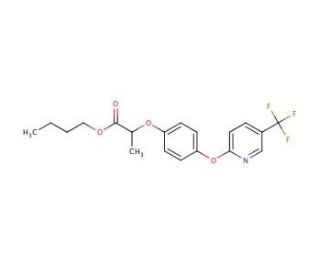

Fluazifop-butyl (CAS 69806-50-4)
LINK RAPIDI
Il fluazifop-butile è un erbicida selettivo di post-emergenza ampiamente utilizzato nella ricerca chimica agricola per studiare il controllo delle infestanti, in particolare delle specie erbacee. Il composto appartiene al gruppo degli arilossifenossipropionati e funziona inibendo l'acetil-CoA carbossilasi (ACCase), un enzima fondamentale per la biosintesi degli acidi grassi nelle piante. La specificità del fluazifop-butile per l'ACCasi nelle specie erbacee lo rende utile per i ricercatori che studiano i meccanismi di tossicità selettiva e lo sviluppo della resistenza nelle popolazioni di erbe infestanti target. Inoltre, viene utilizzato in studi agronomici per valutare l'impatto dell'applicazione di erbicidi sulla resa delle colture, sulla biodiversità delle erbe e sull'ambiente. La ricerca sul fluazifop-butile contribuisce alla comprensione delle pratiche di gestione integrata delle infestanti, con l'obiettivo di ottimizzare l'uso degli erbicidi riducendo al minimo gli effetti ecologici negativi.
Fluazifop-butyl (CAS 69806-50-4) Referenze
- Degradazione enantioselettiva e stabilità chirale dell'erbicida fluazifop-butile nel suolo e nell'acqua. | Qi, Y., et al. 2016. Chemosphere. 146: 315-22. PMID: 26735732
- Comportamento enantioselettivo dell'erbicida fluazifop-butile nei vegetali e nel suolo. | Qi, Y., et al. 2017. Food Chem. 221: 1120-1127. PMID: 27979068
- Metodo assistito da cromatografia a convergenza a ultra-prestazioni con spettrometria di massa tandem per la rapida enantioseparazione e determinazione del fluazifop-butile nel tabacco e nel suolo. | Yang, F., et al. 2019. Chirality. 31: 353-361. PMID: 30849198
- Effetti dell'erbicida selettivo fluazifop sulla sintesi degli acidi grassi nel pisello (Pisum sativum) e nell'orzo (Hordeum vulgare). | Walker, KA., et al. 1988. Biochem J. 254: 811-7. PMID: 3196294
- Sintesi e applicazione delle trifluorometilpiridine come motivo strutturale chiave negli ingredienti attivi agrochimici e farmaceutici. | Tsukamoto, M., et al. 2021. J Pestic Sci. 46: 125-142. PMID: 34135675
- Determinazione cromatografica liquida ad alta prestazione di Fluazifop-butile e Fluazifop nel suolo e nell'acqua. | Negre, M., et al. 1987. J Chromatogr. 387: 541-5. PMID: 3558642
- Confronto tra due metodi per determinare la tossicocinetica del fluazifop-butile dopo somministrazione endovenosa nei ratti. | Rawlings, JM., et al. 1994. Hum Exp Toxicol. 13: 123-9. PMID: 7908809
- Effetto del veicolo di dosaggio sull'assorbimento cutaneo di fluazifop-butile e fomesafen nei ratti in vivo. | Rawlings, JM., et al. 1994. Fundam Appl Toxicol. 23: 93-100. PMID: 7958570
- L'accuratezza predittiva delle misurazioni in vitro per l'assorbimento cutaneo di un penetrante lipofilo (fluazifop-butile) attraverso la pelle di ratto e umana. | Ramsey, JD., et al. 1994. Fundam Appl Toxicol. 23: 230-6. PMID: 7982531
- Modellazione della farmacocinetica cutanea utilizzando dati in vitro. Parte I. Fluazifop-butile nel ratto. | Auton, TR., et al. 1993. Hum Exp Toxicol. 12: 199-206. PMID: 8100430
- Metabolismo microbico del fluazifop-butile. | Nègre, M., et al. 1993. J Environ Sci Health B. 28: 545-76. PMID: 8409232
- Destino del fluazifop butile nella pelle del ratto e dell'uomo in vitro. | Clark, NW., et al. 1993. Arch Toxicol. 67: 44-8. PMID: 8452479
- Effetto degli erbicidi difenileteri e dell'oxadiazon sulla biosintesi delle porfirine nel fegato di topo, nella coltura di epatociti primari di ratto e nelle cellule HepG2. | Krijt, J., et al. 1993. Arch Toxicol. 67: 255-61. PMID: 8517781
Informazioni ordini
| Nome del prodotto | Codice del prodotto | UNITÀ | Prezzo | Quantità | Preferiti | |
Fluazifop-butyl, 250 mg | sc-235142 | 250 mg | $92.00 |