
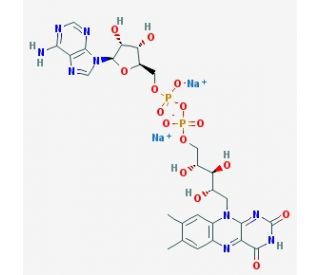

Flavin Adenine Dinucleotide Disodium Salt (CAS 84366-81-4)
QUICK LINKS
Flavin Adenine Dinucleotide Disodium Salt, known as FAD, is a vital cofactor involved in many enzymatic reactions within cells. In research, Flavin Adenine Dinucleotide Disodium Salt is extensively used in the study of redox reactions, where it functions as an electron carrier, accepting and donating electrons during biochemical processes. Its role is in the investigation of metabolic pathways like the citric acid cycle and oxidative phosphorylation, where it participates in the generation of cellular energy. Biochemists use Flavin Adenine Dinucleotide Disodium Salt to probe the mechanisms of flavoproteins, enzymes that utilize this cofactor to catalyze a variety of reactions, including the oxidation of substrates or the reduction of molecular oxygen. In the field of biotechnology, Flavin Adenine Dinucleotide Disodium Salt is also instrumental in designing biosensors, due to its ability to undergo reversible redox reactions, which can be monitored electrochemically. Moreover, Flavin Adenine Dinucleotide Disodium Salt′s involvement in the electron transport chain makes it a key molecule in studies aimed at understanding the effects of metabolic inhibitors and the development of energy production strategies in both eukaryotic and prokaryotic cells.
Flavin Adenine Dinucleotide Disodium Salt (CAS 84366-81-4) References
- Diabetes does not alter the activity and localisation of nitric oxide synthase in the rat anococcygeus muscle. | Way, KJ., et al. 1999. J Auton Nerv Syst. 76: 35-44. PMID: 10323305
- Nonionic micellar liquid chromatography coupled to immobilized enzyme reactors. | Tomer, S., et al. 2001. J Chromatogr A. 923: 7-16. PMID: 11510562
- Peroxisome proliferator-activated receptor agonists inhibit interleukin-1beta-mediated nitric oxide production in cultured lacrimal gland acinar cells. | Beauregard, C. and Brandt, PC. 2003. J Ocul Pharmacol Ther. 19: 579-87. PMID: 14733715
- Photoinduced reductive repair of thymine glycol: implications for excess electron transfer through DNA containing modified bases. | Ito, T., et al. 2006. J Am Chem Soc. 128: 10934-42. PMID: 16910690
- Characterization of the two-component, FAD-dependent monooxygenase SgcC that requires carrier protein-tethered substrates for the biosynthesis of the enediyne antitumor antibiotic C-1027. | Lin, S., et al. 2008. J Am Chem Soc. 130: 6616-23. PMID: 18426211
- Comparison of high-pressure liquid chromatography (HPLC) and Griess reagent-spectroscopic methods for the measurement of nitrate in serum from healthy individuals in the Nordic countries. | Larsen, TL., et al. 2008. Clin Biochem. 41: 1474-81. PMID: 18804102
- Determination of D-serine and D-alanine in the tissues and physiological fluids of mice with various D-amino-acid oxidase activities using two-dimensional high-performance liquid chromatography with fluorescence detection. | Miyoshi, Y., et al. 2009. J Chromatogr B Analyt Technol Biomed Life Sci. 877: 2506-12. PMID: 19586804
- Electrochemical synthesis and characterization of TiO(2) nanoparticles and their use as a platform for flavin adenine dinucleotide immobilization and efficient electrocatalysis. | Ashok Kumar, S., et al. 2008. Nanotechnology. 19: 255501. PMID: 21828652
- Electrochemical switching of photoelectrochemical processes at CdS QDs and photosystem I-modified electrodes. | Efrati, A., et al. 2012. ACS Nano. 6: 9258-66. PMID: 23009682
- Thiol-mediated multiple mechanisms centered on selenodiglutathione determine selenium cytotoxicity against MCF-7 cancer cells. | Tobe, T., et al. 2015. J Biol Inorg Chem. 20: 687-94. PMID: 25783495
- Blue light irradiation-induced oxidative stress in vivo via ROS generation in rat gingival tissue. | Yoshida, A., et al. 2015. J Photochem Photobiol B. 151: 48-53. PMID: 26163948
- Identification of possible light emitters in the gills of a bioluminescent fungus Mycena chlorophos. | Teranishi, K. 2016. Luminescence. 31: 1407-1413. PMID: 27021064
- Fluorescent turn-on sensing of bacterial lipopolysaccharide in artificial urine sample with sensitivity down to nanomolar by tetraphenylethylene based aggregation induced emission molecule. | Jiang, G., et al. 2016. Biosens Bioelectron. 85: 62-67. PMID: 27155117
- Stilbene compounds are specific inhibitors of the superoxide anion generation catalyzed by xanthine oxidase. | Masuoka, N. 2021. Food Chem X. 12: 100146. PMID: 34761201
- In vivo blockage of nitric oxide with aminoguanidine inhibits immunosuppression induced by an attenuated strain of Salmonella typhimurium, potentiates Salmonella infection, and inhibits macrophage and polymorphonuclear leukocyte influx into the spleen. | MacFarlane, AS., et al. 1999. Infect Immun. 67: 891-8. PMID: 9916105
Ordering Information
| Product Name | Catalog # | UNIT | Price | Qty | FAVORITES | |
Flavin Adenine Dinucleotide Disodium Salt, 100 mg | sc-294595 | 100 mg | $94.00 | |||
Flavin Adenine Dinucleotide Disodium Salt, 1 g | sc-294595A | 1 g | $425.00 |