
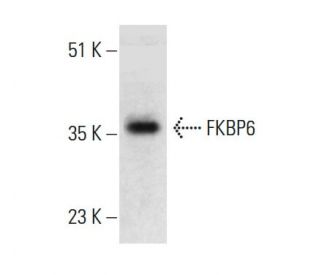

FKBP6 Antibody (AT9B7): sc-517401
- FKBP6 Antibody (AT9B7) is a mouse monoclonal IgG1 κ provided at 100 µg/ml
- raised against a recombinant protein corresponding to amino acids 1-327 of FKBP6 of human origin
- recommended for detection of FKBP6 of human origin by WB, IP and ELISA
- At present, we have not yet completed the identification of the preferred secondary detection reagent(s) for FKBP6 Antibody (AT9B7). This work is in progress.

FKBP6 Antibody (AT9B7) is a mouse monoclonal IgG1 kappa light chain antibody that detects the FKBP6 protein of human origin by western blotting (WB), immunoprecipitation (IP), and enzyme-linked immunosorbent assay (ELISA). Anti-FKBP6 antibody (AT9B7) is available in a non-conjugated form, providing researchers with a versatile tool for studying this important protein. FKBP6, also known as FK506-binding protein 6, Rotamase, Immunophilin FKBP36, and Peptidyl-prolyl cis-trans isomerase FKBP6, is a 327 amino acid protein that plays a crucial role in protein folding by accelerating the isomerization of proline residues, a process essential for proper protein conformation and function. FKBP6 is particularly significant in male fertility, serving as a key component of synaptonemal complexes, which facilitate the pairing of homologous chromosomes during meiosis. Disruptions in FKBP6 function have been linked to male infertility in mice and may also influence susceptibility to idiopathic spermatogenic impairment in humans. FKBP6 shows ubiquitous expression across various tissues, with elevated levels in the testis, liver, kidney, skeletal muscle, and heart, highlighting its importance in multiple biological processes. The gene encoding FKBP6 is located on human chromosome 7, a region associated with Williams-Beuren syndrome, a rare developmental disorder characterized by cardiovascular and musculoskeletal abnormalities. Hemizygous deletion of FKBP6 has been implicated in contributing to hypercalcemia and growth delays observed in individuals with Williams-Beuren syndrome, underscoring FKBP6′s relevance in both developmental biology and clinical research.
Alexa Fluor® is a trademark of Molecular Probes Inc., OR., USA
LI-COR® and Odyssey® are registered trademarks of LI-COR Biosciences
FKBP6 Antibody (AT9B7) References:
- Essential role of Fkbp6 in male fertility and homologous chromosome pairing in meiosis. | Crackower, MA., et al. 2003. Science. 300: 1291-5. PMID: 12764197
- Autosomal dominant inheritance of Williams-Beuren syndrome in a father and son with haploinsufficiency for FKBP6. | Metcalfe, K., et al. 2005. Clin Dysmorphol. 14: 61-65. PMID: 15770126
- Mutations in the chromosome pairing gene FKBP6 are not a common cause of non-obstructive azoospermia. | Westerveld, GH., et al. 2005. Mol Hum Reprod. 11: 673-5. PMID: 16227348
- Is a genetic defect in Fkbp6 a common cause of azoospermia in humans? | Miyamato, T., et al. 2006. Cell Mol Biol Lett. 11: 557-69. PMID: 16983454
- Mutation screening of the FKBP6 gene and its association study with spermatogenic impairment in idiopathic infertile men. | Zhang, W., et al. 2007. Reproduction. 133: 511-6. PMID: 17307919
- Comparing two diagnostic laboratory tests for Williams syndrome: fluorescent in situ hybridization versus multiplex ligation-dependent probe amplification. | van Hagen, JM., et al. 2007. Genet Test. 11: 321-7. PMID: 17949295
- Induced chromosome deletions cause hypersociability and other features of Williams-Beuren syndrome in mice. | Li, HH., et al. 2009. EMBO Mol Med. 1: 50-65. PMID: 20049703
- A novel human gene FKBP6 is deleted in Williams syndrome. | Meng, X., et al. 1998. Genomics. 52: 130-7. PMID: 9782077
Ordering Information
| Product Name | Catalog # | UNIT | Price | Qty | FAVORITES | |
FKBP6 Antibody (AT9B7) | sc-517401 | 100 µg/ml | $322.00 |