
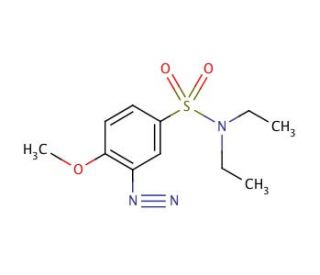

Fast Red ITR Salt (CAS 27580-14-9)
QUICK LINKS
Fast Red ITR Salt, also known as 1-(2,4-Dinitrophenylazo)-2-naphthol, is a synthetic organic compound used as a dye and staining reagent in various biological and histological applications. It belongs to the azo dye family and is characterized by its bright red color. Fast Red ITR Salt has excellent solubility in water, making it easily dispersible and suitable for use in aqueous-based systems. Its vibrant red hue allows for clear visualization and differentiation of stained samples, aiding in the examination of cellular structures and tissue components. In the field of histology and pathology, Fast Red ITR Salt is frequently utilized as a chromogen in immunohistochemistry (IHC) and immunocytochemistry (ICC) procedures. It serves as a substrate for the detection of specific target antigens, usually in conjunction with an appropriate antibody conjugated with an enzyme such as alkaline phosphatase or horseradish peroxidase. The resulting colored reaction product provides visual evidence of the presence and localization of the target molecule within the sample. Fast Red ITR Salt is also employed in other biological techniques, including fluorescence microscopy and cell labeling studies. It can be used to label cells or specific cellular components, allowing researchers to track and identify particular structures of interest. In summary, Fast Red ITR Salt is a versatile red dye widely used in biological and histological applications. Its solubility in water, bright color, and compatibility with various staining techniques make it useful for visualizing and studying cellular structures and molecular targets.
Fast Red ITR Salt (CAS 27580-14-9) References
- Expression and role of mannose receptor/terminal high-mannose type oligosaccharide on osteoclast precursors during osteoclast formation. | Morishima, S., et al. 2003. J Endocrinol. 176: 285-92. PMID: 12553877
- Vitamin K2 and geranylgeraniol, its side chain component, inhibited osteoclast formation in a different manner. | Hiruma, Y., et al. 2004. Biochem Biophys Res Commun. 314: 24-30. PMID: 14715241
- Expression and possible role of PVR/CD155/Necl-5 in osteoclastogenesis. | Kakehi, S., et al. 2007. Mol Cell Biochem. 301: 209-17. PMID: 17286202
- The role of Mac-1 (CD11b/CD18) in osteoclast differentiation induced by receptor activator of nuclear factor-kappaB ligand. | Hayashi, H., et al. 2008. FEBS Lett. 582: 3243-8. PMID: 18775427
- Tissue-specific inhibition and recovery of esterase activities in Lumbricus terrestris experimentally exposed to chlorpyrifos. | Vejares, SG., et al. 2010. Comp Biochem Physiol C Toxicol Pharmacol. 151: 351-9. PMID: 20045489
- The effects of polyunsaturated fatty acids and their metabolites on osteoclastogenesis in vitro. | Yuan, J., et al. 2010. Prostaglandins Other Lipid Mediat. 92: 85-90. PMID: 20394833
- New synthetic substrate for kallikrein and its application. | Fujii, S., et al. 1986. Adv Exp Med Biol. 198 Pt A: 299-308. PMID: 2949541
- Locating salmonella resistance gene on mouse chromosome 1. | Plant, J. and Glynn, AA. 1979. Clin Exp Immunol. 37: 1-6. PMID: 385184
- Immunoalkaline phosphatase cytochemistry. Technical considerations of endogenous phosphatase activity. | Janckila, AJ., et al. 1985. Am J Clin Pathol. 84: 476-80. PMID: 3898810
- Immunocytochemical characterization of human blood cells. | Yam, LT., et al. 1983. Am J Clin Pathol. 80: 314-21. PMID: 6192705
- Interference with the kinetic determination of acid phosphatase. | Sanders, GT., et al. 1978. Clin Chim Acta. 89: 421-7. PMID: 709884
- The inhibitory effect of vitamin K2 (menatetrenone) on bone resorption may be related to its side chain. | Hara, K., et al. 1995. Bone. 16: 179-84. PMID: 7756045
- Involvement of adhesion molecules LFA-1 and ICAM-1 in osteoclast development. | Kurachi, T., et al. 1993. Biochim Biophys Acta. 1178: 259-66. PMID: 7779165
- Effect of vitamin K2 (menatetrenone) on osteoclast-like cell formation in mouse bone marrow cultures. | Akiyama, Y., et al. 1994. Eur J Pharmacol. 263: 181-5. PMID: 7821350
- Expression of IL-6 receptor and GP130 in mouse bone marrow cells during osteoclast differentiation. | Gao, Y., et al. 1998. Bone. 22: 487-93. PMID: 9600782
Ordering Information
| Product Name | Catalog # | UNIT | Price | Qty | FAVORITES | |
Fast Red ITR Salt, 25 g | sc-255169 | 25 g | $200.00 |