
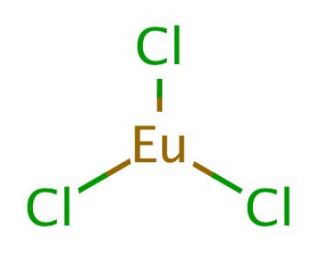

Europium(III) chloride (CAS 10025-76-0)
QUICK LINKS
Europium(III) chloride is a water-soluble ionic halide salt with a low melting point. When exposed to ultraviolet light, it emits light, likely from its fluorescent properties. The intensity of this fluorescence increases at higher pH levels, due to the formation of an acid complex that weakens the metal-ligand bond, enhancing the redox potentials. The compound′s characteristics can be influenced by pH, acidity, and the concentration of other ions present. Europium(III) chloride is used as a hydrogenation catalyst and in analytical techniques like spectroscopy and electrochemistry. It′s also used in luminescence research, magnetic resonance imaging, and as a phosphor in lighting. Additionally, due to its distinctive optical qualities, it′s used as a dopant in optical fibers and waveguides.
Europium(III) chloride (CAS 10025-76-0) References
- Measurement of the binding of cholera toxin to GM1 gangliosides on solid supported lipid bilayer vesicles and inhibition by europium (III) chloride. | Williams, TL. and Jenkins, AT. 2008. J Am Chem Soc. 130: 6438-43. PMID: 18412339
- Arc discharge ion source for europium and other refractory metals implantation. | Turek, M., et al. 2009. Rev Sci Instrum. 80: 043304. PMID: 19405653
- Novel fluorescent probe for low density lipoprotein, based on the enhancement of Europium emission band. | Courrol, LC., et al. 2007. Opt Express. 15: 7066-74. PMID: 19547024
- Distribution, elimination, and renal effects of single oral doses of europium in rats. | Ohnishi, K., et al. 2011. Biol Trace Elem Res. 143: 1054-63. PMID: 21221839
- Influence of catalyses on the preparation of YVO4:Eu 3+ phosphors by the sol-gel methodology. | Saltarelli, M., et al. 2012. J Fluoresc. 22: 899-906. PMID: 22205247
- Use of europium ions for SAD phasing of lysozyme at the Cu Kα wavelength. | Vijayakumar, B. and Velmurugan, D. 2013. Acta Crystallogr Sect F Struct Biol Cryst Commun. 69: 20-4. PMID: 23295480
- Electrochemistry and Spectroelectrochemistry of europium(III) chloride in 3LiCl-2KCl from 643 to 1123 K. | Schroll, CA., et al. 2013. Anal Chem. 85: 9924-31. PMID: 24016214
- Redetermination of [EuCl2(H2O)6]Cl. | Tambornino, F., et al. 2014. Acta Crystallogr Sect E Struct Rep Online. 70: i27. PMID: 24940187
- Europium as an inhibitor of Amyloid-β(1-42) induced membrane permeation. | Williams, TL., et al. 2015. FEBS Lett. 589: 3228-36. PMID: 26450778
- Highly Luminescent and Anti-Photobleaching Core-Shell Structure of Mesoporous Silica and Phosphatidylcholine Modified Superparamagnetic Iron Oxide Nanoparticles. | Kim, MY., et al. 2020. Nanomaterials (Basel). 10: PMID: 32635432
- The Role of Temperature on the Degree of End-Closing and Filling of Single-Walled Carbon Nanotubes. | Kierkowicz, M., et al. 2021. Nanomaterials (Basel). 11: PMID: 34947714
Ordering Information
| Product Name | Catalog # | UNIT | Price | Qty | FAVORITES | |
Europium(III) chloride, 1 g | sc-257522 | 1 g | $88.00 |