
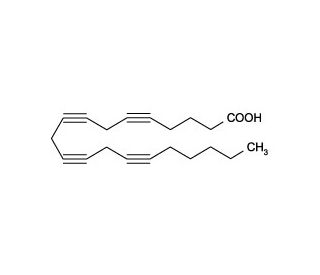

ETYA (CAS 1191-85-1)
See product citations (3)
QUICK LINKS
ETYA, or 5,8,11,14-eicosatetraynoic acid, is a potent inhibitor of arachidonic acid metabolism, impacting key pathways such as the cyclooxygenase and lipoxygenase pathways, which are necessary for the production of various eicosanoids. This modification of eicosanoid synthesis makes ETYA a useful in the study of inflammatory processes and the modulation of cellular signaling pathways. In research settings, ETYA is used to dissect the roles of prostaglandins and leukotrienes in cellular responses, offering insights into the complex interactions within cellular inflammatory pathways. Its ability to interfere with lipid signaling molecules extends its use in exploring mechanisms of cell proliferation, differentiation, and apoptosis in various experimental models, thereby broadening our understanding of cellular physiology and the underlying biochemical landscapes of inflammation and cellular regulation.
ETYA (CAS 1191-85-1) References
- Eicosatetraynoic acid (ETYA), a non-metabolizable analogue of arachidonic acid, blocks the fast-inactivating potassium current of rat pituitary melanotrophs. | Kehl, SJ. 2001. Can J Physiol Pharmacol. 79: 338-45. PMID: 11332511
- ETYA, a pleotropic membrane-active arachidonic acid analogue affects multiple signal transduction pathways in cultured transformed mammalian cells. | Anderson, KM., et al. 1992. Clin Biochem. 25: 1-9. PMID: 1551235
- Activation of TRPA1 by farnesyl thiosalicylic acid. | Maher, M., et al. 2008. Mol Pharmacol. 73: 1225-34. PMID: 18171730
- Targetted destruction of PC3 mitochondria by ETYA: a 'Trojan horse' membrane-suicide molecule. | Anderson, KM. and Harris, JE. 1991. Med Hypotheses. 35: 151-3. PMID: 1909769
- Probing conformational changes in lipoxygenases upon membrane binding: fine-tuning by the active site inhibitor ETYA. | Di Venere, A., et al. 2014. Biochim Biophys Acta. 1841: 1-10. PMID: 24012824
- Antagonism by ETYA of the effects of leukotrienes on ileum and lung parenchymal strips independent of effects on arachidonic acid metabolism. | Hageman, WE., et al. 1986. Prostaglandins. 32: 563-78. PMID: 3099334
- Incorporation of 5,8,11,14-eicosatetraynoic acid (ETYA) into cell lipids: competition with arachidonic acid for esterification. | Taylor, AS., et al. 1985. Prostaglandins. 29: 449-58. PMID: 3923563
- Lysosomal enzyme release from human granulocytes is inhibited by indomethacin, ETYA, and BPB. | Smolen, JE. and Weissmann, G. 1980. Adv Prostaglandin Thromboxane Res. 8: 1695-700. PMID: 6246788
- 5,8,11,14-Eicosatetraynoic acid (ETYA) inhibits binding of N-formyl-methionyl-leucyl-phenylalanine (FLMP) to its receptor on human granulocytes. A note of caution. | Atkinson, JP., et al. 1982. Immunopharmacology. 4: 1-9. PMID: 6277829
- Epoxyeicosatrienoic acids stimulate glucagon and insulin release from isolated rat pancreatic islets. | Falck, JR., et al. 1983. Biochem Biophys Res Commun. 114: 743-9. PMID: 6411091
- Effects of antioxidants on cyclooxygenase and lipoxygenase activities in intact human platelets: comparison with indomethacin and ETYA. | Van Wauwe, J. and Goossens, J. 1983. Prostaglandins. 26: 725-30. PMID: 6422509
- An inhibitor of arachidonic acid metabolism stimulates luteinizing hormone (LH) release from cultured pituitary cells. | Conn, PM., et al. 1980. Prostaglandins. 19: 873-9. PMID: 6770421
- Effect of ETYA and BW 755c on arachidonate-induced contractions in the guinea-pig isolated trachea. | Mitchell, HW. 1982. Br J Pharmacol. 76: 527-9. PMID: 6809090
- Phospholipase A2-induced rat mast cell secretion. Role of arachidonic acid metabolites. | Chi, EY., et al. 1982. Lab Invest. 47: 579-85. PMID: 6815379
Ordering Information
| Product Name | Catalog # | UNIT | Price | Qty | FAVORITES | |
ETYA, 20 mg | sc-200764 | 20 mg | $75.00 | |||
ETYA, 100 mg | sc-200764A | 100 mg | $313.00 |