
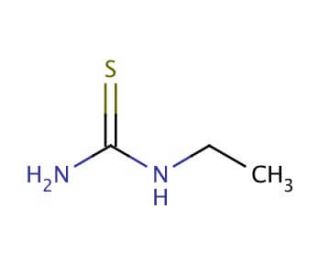

Ethylthiourea (CAS 625-53-6)
LINK RAPIDI
L'etiltiourea è un composto organosolforato ampiamente utilizzato nella ricerca per studiare le sue diverse attività biologiche e proprietà chimiche. Il suo meccanismo d'azione prevede principalmente l'inibizione dell'attività enzimatica attraverso l'interazione con i gruppi tiolici, che può portare all'interruzione di varie vie biochimiche. L'etiltiourea è stata impiegata in studi che hanno indagato il suo ruolo di inibitore della tirosinasi, un enzima fondamentale nella sintesi della melanina, rendendola uno strumento prezioso nella ricerca sulla pigmentazione e sulla regolazione degli enzimi. Inoltre, è stato utilizzato nella sintesi di altri composti contenenti zolfo e come ligando nella chimica di coordinazione, favorendo l'esplorazione di complessi metallici con potenziali proprietà catalitiche. La ricerca recente si è concentrata sull'impatto ambientale e sulle vie di degradazione dell'etiltiourea, esaminando la sua persistenza e trasformazione in diversi ecosistemi. Per caratterizzare le sue interazioni e la sua stabilità sono state utilizzate tecniche analitiche avanzate come la spettrometria di massa e la spettroscopia di risonanza magnetica nucleare (NMR). Inoltre, l'etiltiourea funge da composto modello negli studi tossicologici per comprendere gli effetti dei derivati della tiourea sui sistemi biologici, fornendo approfondimenti sui loro meccanismi di tossicità e sui potenziali pericoli ambientali. Le sue molteplici applicazioni ne evidenziano l'importanza nella ricerca chimica, biologica e ambientale.
Ethylthiourea (CAS 625-53-6) Referenze
- Nuovi composti tiourea come microbicidi a doppia funzione. | D'Cruz, OJ., et al. 2000. Biol Reprod. 63: 196-205. PMID: 10859260
- Spettri infrarossi di nuovi complessi di Re(III) con derivati della tiourea. | Gambino, D., et al. 2002. Spectrochim Acta A Mol Biomol Spectrosc. 58: 3085-92. PMID: 12511092
- Preferenze conformazionali e rotazione interna in derivati di tiourea alchilici e fenilici sostituiti. | Bryantsev, VS. and Hay, BP. 2006. J Phys Chem A. 110: 4678-88. PMID: 16599434
- Sintesi e proprietà citostatiche di derivati della daunorubicina, contenenti società N-feniltiourea o N-etiltiourea in posizione 3'-. | Preobrazhenskaya, MN., et al. 1991. J Antibiot (Tokyo). 44: 192-9. PMID: 1901311
- Presentato il primo rapporto sulla modellazione in silico della tossicità acquatica di sostanze chimiche organiche per Labeo rohita (Rohu) utilizzando QSAR e q-RASAR. | Gallagher, A. and Kar, S. 2024. Chemosphere. 349: 140810. PMID: 38029938
Informazioni ordini
| Nome del prodotto | Codice del prodotto | UNITÀ | Prezzo | Quantità | Preferiti | |
Ethylthiourea, 10 g | sc-203333 | 10 g | $138.00 |