
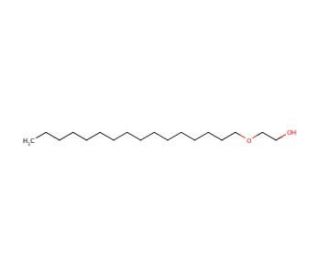

Ethylene glycol monohexadecyl ether (CAS 2136-71-2)
QUICK LINKS
Ethylene glycol monohexadecyl ether, also known as C16E1, is a non-ionic surfactant commonly utilized in various research applications due to its amphiphilic properties and surfactant behavior. Its mechanism of action involves the formation of micelles in solution, where the hydrophilic ethylene glycol head group orients towards the aqueous phase, while the hydrophobic hexadecyl tail group resides in the core, effectively solubilizing hydrophobic compounds. C16E1 has been extensively employed in biophysical studies, particularly in membrane protein research, where it serves as a detergent for solubilizing and stabilizing integral membrane proteins, such as G protein-coupled receptors (GPCRs) and ion channels, for structural and functional analyses. Furthermore, C16E1 has found applications in nanotechnology and colloidal science, where it is utilized in the synthesis of nanoparticles, vesicles, and micelles for drug delivery, imaging, and catalysis studies. Its ability to modulate the physicochemical properties of lipid bilayers has also led to its use in membrane mimetic systems for studying membrane-protein interactions and lipid-protein dynamics. Overall, Ethylene glycol monohexadecyl ether serves as a versatile tool in various fields of research, facilitating the study of complex biological and physicochemical phenomena.
Ethylene glycol monohexadecyl ether (CAS 2136-71-2) References
- Cationic oxyethylene lipids. Synthesis, aggregation, and transfection properties. | Bhattacharya, S. and Dileep, PV. 2004. Bioconjug Chem. 15: 508-19. PMID: 15149178
- Characterisation of ethoxylated fatty chains of anionic surfactants and determination of residual ethoxylated fatty alcohols. | Morvan, J., et al. 2006. Anal Bioanal Chem. 384: 1409-15. PMID: 16501957
- Supercritical fluid chromatography with light-scattering detection. I. Preliminary results of the analysis of polar compounds with packed columns. | Lafosse, M., et al. 1990. J Chromatogr. 505: 191-7. PMID: 2370280
- Validation of Quantitative Structure-Activity Relationship (QSAR) and Quantitative Structure-Property Relationship (QSPR) approaches as alternatives to skin sensitization risk assessment. | Kim, JY., et al. 2021. J Toxicol Environ Health A. 84: 945-959. PMID: 34338166
- Discrimination of toxigenic and non-toxigenic Aspergillus flavus in wheat based on nanocomposite colorimetric sensor array. | Chen, Z., et al. 2024. Food Chem. 430: 137048. PMID: 37544158
- Prediction of skin sensitization using machine learning. | Im, JE., et al. 2023. Toxicol In Vitro. 93: 105690. PMID: 37660996
- Synthesis of novel cationic lipids with oxyethylene spacers at the linkages between hydrocarbon chains and pseudoglyceryl backbone. | Bhattacharya, Santanu and P. V. Dileep. 1999. Tetrahedron letters. 40.46: 8167-8171.
- Hydrodynamic effect of oxygenated byproduct during Fischer–Tropsch synthesis in slurry bubble column. | Yang, Jung Hoon, et al. 2013. Chemical Engineering and Processing-Process Intensification. 66: 27-35.
Ordering Information
| Product Name | Catalog # | UNIT | Price | Qty | FAVORITES | |
Ethylene glycol monohexadecyl ether, 1 g | sc-257517 | 1 g | $360.00 | |||
Ethylene glycol monohexadecyl ether, 5 g | sc-257517A | 5 g | $1400.00 | |||
Ethylene glycol monohexadecyl ether, 10 g | sc-257517B | 10 g | $2250.00 |