
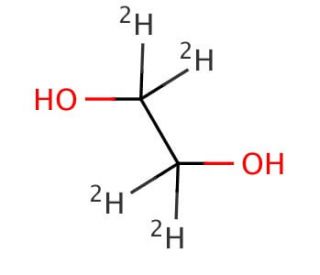

Ethylene-d4 glycol (CAS 2219-51-4)
LINK RAPIDI
Il glicole etilenico-d4 è una forma deuterata del glicole etilenico. È un composto organico costituito da due atomi di deuterio che sostituiscono due atomi di idrogeno nella molecola del glicole etilenico. L'etichettatura con deuterio conferisce proprietà uniche che lo rendono prezioso in varie applicazioni scientifiche. Il glicole etilenico-d4 ha diverse applicazioni scientifiche, in particolare nel campo della chimica. Serve come solvente versatile e come materiale di partenza per le sintesi organiche. La marcatura con deuterio offerta dall'etilene-d4 glicole consente di tracciare e identificare le molecole in sistemi complessi, permettendo ai ricercatori di studiare i meccanismi di reazione, la cinetica e il comportamento delle molecole nei sistemi biologici. È comunemente utilizzato in studi che impiegano tecniche come la spettroscopia di risonanza magnetica nucleare (NMR). Inoltre, l'etilene-d4 glicole trova applicazione nella ricerca farmaceutica. Serve come standard interno isotopico stabile negli studi sul metabolismo dei farmaci e nelle indagini farmacocinetiche. Utilizzando l'etilene-d4 glicole come composto di riferimento, i ricercatori possono misurare con precisione l'assorbimento, la distribuzione, il metabolismo e l'escrezione dei farmaci negli organismi viventi. Queste informazioni aiutano a comprendere l'efficacia dei farmaci, la tossicità e le interazioni con i sistemi biologici. In termini di meccanismo d'azione, il glicole etilenico-d4 condivide proprietà e reattività simili a quelle del glicole etilenico. Si comporta come un diolo, caratterizzato da due gruppi ossidrilici, che gli permettono di partecipare a varie reazioni chimiche. Può subire reazioni di esterificazione, formazione di eteri e ossidazione, tra le altre. Questi modelli di reattività contribuiscono alla sua utilità nella sintesi organica e come solvente in diverse applicazioni scientifiche e industriali.
Ethylene-d4 glycol (CAS 2219-51-4) Referenze
- Studio della formaldeide-C14,D2 come metabolita monocarbonioso nel ratto. | LOWY, BA., et al. 1956. J Biol Chem. 220: 325-39. PMID: 13319352
- Gascromatografia-spettrometria di massa con estrazione in provetta per l'analisi di composti organici idrossilici metil-derivati e volatili nel sangue e nelle urine. | Rasanen, I., et al. 2010. J Anal Toxicol. 34: 113-21. PMID: 20406534
- Validazione di un metodo rapido e automatizzato per la misurazione del glicole etilenico nel plasma umano. | Robson, AF., et al. 2017. Ann Clin Biochem. 54: 481-489. PMID: 27538769
- La somministrazione di PEG 3350 non è associata a un'elevazione sostenuta dei livelli di glicole. | Williams, KC., et al. 2018. J Pediatr. 195: 148-153.e1. PMID: 29395181
- Ru supportato su MnBCD derivato da Mn MOF per la sintesi termocatalitica ed elettrocatalitica di etilene-d4 glicole. | Shao, F., et al. 2023. ChemSusChem. e202202395. PMID: 37012670
- Shift chimici 13C NMR calcolati e misurati dei 2, 4, 6-tricloroeptani e loro implicazioni per gli spettri 13C NMR del poli (cloruro di vinile) | Tonelli, A. E., et al. 1979. Macromolecules. 12: 78-83.
- Rilassamento MR in poli (butilene tereftalato) e poli (butilene tereftalato) contenenti copolimeri segmentati. 5. | Jelinski, Lynn W., et al. 1983. Macromolecules. 16: 409-415.
Informazioni ordini
| Nome del prodotto | Codice del prodotto | UNITÀ | Prezzo | Quantità | Preferiti | |
Ethylene-d4 glycol, 1 g | sc-228089 | 1 g | $199.00 |