
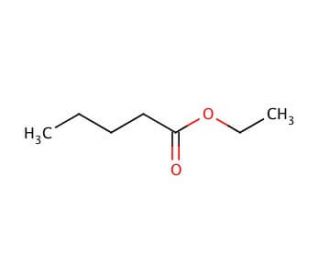

Ethyl valerate (CAS 539-82-2)
QUICK LINKS
Ethyl valerate, an ester derived from valeric acid and ethanol, is a significant compound in research focused on flavor chemistry, synthetic organic chemistry, and material science. Its fruity aroma makes it a useful model for studying esterification processes, providing insights into the kinetics and mechanisms of ester synthesis. This knowledge is particularly relevant in developing catalysts and optimizing reaction conditions in organic chemistry. Moreover, ethyl valerate serves as a volatile organic compound in studies investigating the composition and behavior of esters in various natural matrices like fruits and fermentation products. Researchers analyze its formation and degradation pathways to better understand ester biosynthesis and its relationship with microbial activity. This is crucial in exploring how microbial fermentation can alter ester profiles, which is highly significant for flavor and fragrance chemistry. In material science, ethyl valerate is utilized as a plasticizer to improve the flexibility and durability of polymers. It serves as a model compound to study interactions between plasticizers and polymer matrices, helping researchers comprehend how esters influence mechanical properties. These studies extend to developing new biodegradable plastics and polymer blends where ester interactions significantly impact the thermal and physical behavior of the final product.
Ethyl valerate (CAS 539-82-2) References
- Conformational analysis of green apple flavour: the gas-phase structure of ethyl valerate validated by microwave spectroscopy. | Mouhib, H. and Stahl, W. 2012. Chemphyschem. 13: 1297-301. PMID: 22378626
- Improvement of the enzymatic synthesis of ethyl valerate by esterification reaction in a solvent system. | Corradini, MC., et al. 2017. Prep Biochem Biotechnol. 47: 100-109. PMID: 27136358
- Alternative method to improve the ethyl valerate yield using an immobilised Burkholderia cepacia lipase. | Moreira, WC., et al. 2019. J Microencapsul. 36: 327-337. PMID: 31151367
- Fruity flavors from waste: A novel process to upgrade crude glycerol to ethyl valerate. | Ganigué, R., et al. 2019. Bioresour Technol. 289: 121574. PMID: 31247530
- Ternary biogenic silica/magnetite/graphene oxide composite for the hyperactivation of Candida rugosa lipase in the esterification production of ethyl valerate. | Jacob, AG., et al. 2021. Enzyme Microb Technol. 148: 109807. PMID: 34116744
- Electrospun Magnetic Nanocellulose-Polyethersulfone-Conjugated Aspergillus oryzae Lipase for Synthesis of Ethyl Valerate. | Hussin, NH., et al. 2021. Membranes (Basel). 11: PMID: 34940473
- Characterization of an Aspergillus niger for Efficient Fatty Acid Ethyl Ester Synthesis in Aqueous Phase and the Molecular Mechanism. | Xu, Y., et al. 2021. Front Microbiol. 12: 820380. PMID: 35265050
- Synergistic Effect of Diet and Physical Activity on a NAFLD Cohort: Metabolomics Profile and Clinical Variable Evaluation. | Calabrese, FM., et al. 2023. Nutrients. 15: PMID: 37299420
- Bond dissociation energies of ethyl valerate and tripropionin. | Mukeba, CT., et al. 2023. J Mol Model. 29: 261. PMID: 37482544
- RIFM fragrance ingredient safety assessment, ethyl valerate, CAS Registry Number 539-82-2. | Api, AM., et al. 2024. Food Chem Toxicol. 183 Suppl 1: 114397. PMID: 38141951
Ordering Information
| Product Name | Catalog # | UNIT | Price | Qty | FAVORITES | |
Ethyl valerate, 500 ml | sc-215002 | 500 ml | $83.00 |