
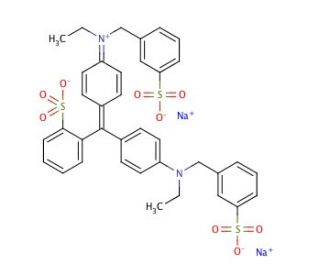

Erioglaucine disodium salt (CAS 3844-45-9)
QUICK LINKS
Erioglaucine disodium salt, known as FD&C Blue No. 1, is a synthetic dye widely utilized in various research applications, particularly in molecular biology and analytical chemistry. This compound operates through its ability to interact with other molecules based on charge and hydrophobicity, making it useful in the visualization of proteins, nucleic acids, and other macromolecules in complex mixtures. Its mechanism of action involves binding selectively to certain biomolecules, which allows for the differentiation or quantification of these components in assays, electrophoresis, and microscopic analysis. The vivid blue color of Erioglaucine disodium salt provides a stark contrast against colorless backgrounds, enhancing the clarity and resolution of experimental observations. In research applications, its role extends beyond mere visualization; it is also used in tracking experiments where the migration of substances needs to be monitored over time, serving as a non-toxic marker that can be easily detected. This dye′s unique properties make it an indispensable reagent in laboratories, facilitating advancements in understanding biological processes and material sciences.
Erioglaucine disodium salt (CAS 3844-45-9) References
- Color fading of the blue compliance indicator encapsulated in removable clear Invisalign Teen® aligners. | Schott, TC. and Göz, G. 2011. Angle Orthod. 81: 185-91. PMID: 21208067
- Patterned adhesive enables construction of nonplanar three-dimensional paper microfluidic circuits. | Kalish, B. and Tsutsui, H. 2014. Lab Chip. 14: 4354-61. PMID: 25222567
- Green Synthesis of Fluorescent Carbon Dots for Selective Detection of Tartrazine in Food Samples. | Xu, H., et al. 2015. J Agric Food Chem. 63: 6707-14. PMID: 26154603
- Applicability of biological dye tracer in strip biosensor for ultrasensitive detection of pathogenic bacteria. | Bu, T., et al. 2019. Food Chem. 274: 816-821. PMID: 30373015
- Measuring the Effects of Bacteria and Chemicals on the Intestinal Permeability of Caenorhabditis elegans. | Le, TAN., et al. 2019. J Vis Exp.. PMID: 31868179
- Response of DBL-1/TGF-β signaling-mediated neuron-intestine communication to nanopolystyrene in nematode Caenorhabditis elegans. | Liu, H., et al. 2020. Sci Total Environ. 745: 141047. PMID: 32758726
- Modifying Wicking Speeds in Paper-Based Microfluidic Devices by Laser-Etching. | Kalish, B., et al. 2020. Micromachines (Basel). 11: PMID: 32823829
- Surface-tension-induced double emulsion drops via phase separation of polymeric fluid confined in micromolds for capsule templates. | Jeong, SG., et al. 2021. J Colloid Interface Sci. 582: 1012-1020. PMID: 32927168
- Evaporation-Induced Diffusion Acceleration in Liquid-Filled Porous Materials. | Wang, X., et al. 2021. ACS Omega. 6: 21646-21654. PMID: 34471768
- Generation of flow and droplets with an ultra-long-range linear concentration gradient. | Dai, B., et al. 2021. Lab Chip. 21: 4390-4400. PMID: 34704106
- Brain uptake and distribution patterns of 2-hydroxypropyl-ß-cyclodextrin after intrathecal and intranasal administration. | Banks, WA., et al. 2022. J Pharm Pharmacol. 74: 1152-1159. PMID: 35596793
- Exposure to nanopolystyrene and its 4 chemically modified derivatives at predicted environmental concentrations causes differently regulatory mechanisms in nematode Caenorhabditis elegans. | Qu, M., et al. 2022. Chemosphere. 305: 135498. PMID: 35777546
- Long-term exposure to tire-derived 6-PPD quinone causes intestinal toxicity by affecting functional state of intestinal barrier in Caenorhabditis elegans. | Hua, X., et al. 2023. Sci Total Environ. 861: 160591. PMID: 36464050
Ordering Information
| Product Name | Catalog # | UNIT | Price | Qty | FAVORITES | |
Erioglaucine disodium salt, 5 g | sc-218328 | 5 g | $27.00 | |||
Erioglaucine disodium salt, 25 g | sc-218328A | 25 g | $71.00 |