
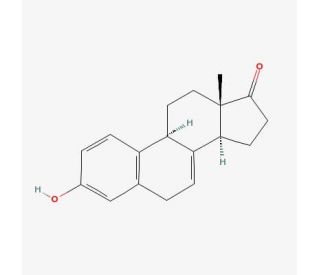

Equilin (CAS 474-86-2)
QUICK LINKS
Equilin is a naturally occurring steroid hormone found predominantly in the female body, specifically within the ovaries and adrenal glands. It belongs to the estrane steroid family and is closely related to estradiol, the primary female sex hormone. Its presence is not limited to humans but extends to certain plants and animals as well. This hormone plays a vital role in regulating female reproductive functions, including ovulation. The influence of Equilin on the human body has been the subject of numerous studies, encompassing a diverse range of contexts, from laboratory experiments to potential applications. It has been employed in laboratory applications to examine the impacts of estrogens on various biological processes, including gene expression, cell proliferation, and hormone receptor expression. Its function and potential applications continue to be a focal point of ongoing research.
Equilin (CAS 474-86-2) References
- Oestrone and equilin in the plasma of the pregnant mare. | Cox, JE. 1975. J Reprod Fertil Suppl. 463-8. PMID: 1060825
- Metabolism of [3H]equilin-[35S]sulfate and [3H]equilin sulfate after oral and intravenous administration in normal postmenopausal women and men. | Bhavnani, BR., et al. 1989. J Clin Endocrinol Metab. 68: 757-65. PMID: 2921309
- Equilin displays similar endothelium-independent vasodilator potential to 17β-estradiol regardless of lower potential to inhibit calcium entry. | Filgueira, FP., et al. 2019. Steroids. 141: 46-54. PMID: 30458188
- Equilin in conjugated equine estrogen increases monocyte-endothelial adhesion via NF-κB signaling. | Ito, F., et al. 2019. PLoS One. 14: e0211462. PMID: 30699196
- Equilin and equilenin biosynthesis. Stereochemistry of aromatization of 3-hydroxy-3,5,7-androstatrien-17-one by horse placenta. | Numazawa, M. and Osawa, Y. 1987. J Steroid Biochem. 26: 137-43. PMID: 3821102
- Microbial aromatization of steroids into equilin. | Sehgal, SN. and Vézina, C. 1970. Appl Microbiol. 20: 875-9. PMID: 5492438
- A microbiological synthesis of equilin from 19-hydroxycholesta-4,7-dien-3-one. | Deghenghi, R., et al. 1967. Steroids. 10: 313-6. PMID: 6057566
- Serum equilin and conjugated equine oestrogens. | Woolever, CA. and Bhavnani, BR. 1980. Lancet. 1: 547-8. PMID: 6102273
- Radioimmunoassay of plasma equilin and estrone in postmenopausal women after the administration of premarin. | Bhavnani, BR., et al. 1981. J Clin Endocrinol Metab. 52: 741-7. PMID: 6259193
- Pharmacokinetics of equilin and equilin sulfate in normal postmenopausal women and men. | Bhavnani, BR., et al. 1983. J Clin Endocrinol Metab. 56: 1048-56. PMID: 6300173
- The metabolism of equilin in normal men. | Bhavnani, BR. and Woolever, CA. 1982. J Steroid Biochem. 17: 217-23. PMID: 7109607
- Metabolism of equilin sulfate in the dog. | Chandrasekaran, A., et al. 1995. J Steroid Biochem Mol Biol. 55: 271-8. PMID: 7495708
- Equilin, a principal component of the estrogen replacement therapy premarin, increases the growth of cortical neurons via an NMDA receptor-dependent mechanism. | Brinton, RD., et al. 1997. Exp Neurol. 147: 211-20. PMID: 9344546
Ordering Information
| Product Name | Catalog # | UNIT | Price | Qty | FAVORITES | |
Equilin, 50 mg | sc-239857 | 50 mg | $137.00 | |||
Equilin, 500 mg | sc-239857A | 500 mg | $988.00 | |||
Equilin, 1 g | sc-239857B | 1 g | $1685.00 |