
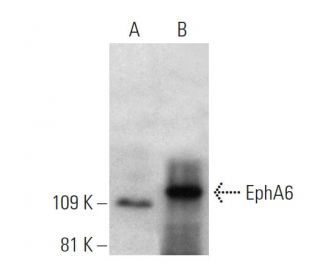

EphA6 Antibody (1426CT591.205.91.119): sc-517327
- EphA6 Antibody (1426CT591.205.91.119) is a mouse monoclonal IgG1 κ EphA6 antibody provided at 100 µg/ml
- raised against a recombinant protein corresponding to EphA6 of human origin
- recommended for detection of EphA6 of human origin by WBIP
- At present, we have not yet completed the identification of the preferred secondary detection reagent(s) for EphA6 Antibody (1426CT591.205.91.119). This work is in progress.

EphA6 Antibody (1426CT591.205.91.119) is a mouse monoclonal IgG1 kappa light chain antibody that detects the EphA6 protein of human origin by western blotting (WB) and immunoprecipitation (IP). Anti-EphA6 antibody (1426CT591.205.91.119) is available as a non-conjugated antibody and plays a crucial role in the study of receptor protein tyrosine kinases, which are the largest group of such receptors identified to date. EphA6 monoclonal antibody (1426CT591.205.91.119) is primarily located in the cell membrane, where EphA6 functions as a receptor that interacts with ephrin ligands, facilitating cell signaling processes vital for various biological functions, including neuronal development and tissue patterning. EphA6 (1426CT591.205.91.119) antibody′s membrane localization enables bidirectional signaling between cells, essential for processes such as axon guidance and synaptic plasticity in the central nervous system. Understanding EphA6 dynamics and interactions can provide insights into developmental disorders and neurodegenerative diseases, making EphA6 a significant target for research in both basic and applied sciences.
Alexa Fluor® is a trademark of Molecular Probes Inc., OR., USA
LI-COR® and Odyssey® are registered trademarks of LI-COR Biosciences
EphA6 Antibody (1426CT591.205.91.119) References:
- HOXA13 directly regulates EphA6 and EphA7 expression in the genital tubercle vascular endothelia. | Shaut, CA., et al. 2007. Dev Dyn. 236: 951-60. PMID: 17304517
- EphA6 promotes angiogenesis and prostate cancer metastasis and is associated with human prostate cancer progression. | Li, S., et al. 2015. Oncotarget. 6: 22587-97. PMID: 26041887
- EphA5 and EphA6: regulation of neuronal and spine morphology. | Das, G., et al. 2016. Cell Biosci. 6: 48. PMID: 27489614
- Circulating Long Noncoding RNA LNC-EPHA6 Associates with Acute Rejection after Kidney Transplantation. | Groeneweg, KE., et al. 2020. Int J Mol Sci. 21: PMID: 32764470
- EPHA2, EPHA4, and EPHA6 Expression in Uveal Melanomas: Searching for the Culprits of Neoplasia. | Pergaris, A., et al. 2022. Diagnostics (Basel). 12: PMID: 35626181
- Identification and cloning of ELF-1, a developmentally expressed ligand for the Mek4 and Sek receptor tyrosine kinases. | Cheng, HJ. and Flanagan, JG. 1994. Cell. 79: 157-68. PMID: 7522971
- Molecular cloning of a ligand for the EPH-related receptor protein-tyrosine kinase Htk. | Bennett, BD., et al. 1995. Proc Natl Acad Sci U S A. 92: 1866-70. PMID: 7534404
- Identification of full-length and truncated forms of Ehk-3, a novel member of the Eph receptor tyrosine kinase family. | Valenzuela, DM., et al. 1995. Oncogene. 10: 1573-80. PMID: 7731712
- Identification of alternatively spliced mRNAs encoding variants of MDK1, a novel receptor tyrosine kinase expressed in the murine nervous system. | Ciossek, T., et al. 1995. Oncogene. 10: 97-108. PMID: 7824284
- Ligands for the receptor tyrosine kinases hek and elk: isolation of cDNAs encoding a family of proteins. | Kozlosky, CJ., et al. 1995. Oncogene. 10: 299-306. PMID: 7838529
- cDNA cloning and tissue distribution of five human EPH-like receptor protein-tyrosine kinases. | Fox, GM., et al. 1995. Oncogene. 10: 897-905. PMID: 7898931
- Molecular characterization of a family of ligands for eph-related tyrosine kinase receptors. | Beckmann, MP., et al. 1994. EMBO J. 13: 3757-62. PMID: 8070404
Ordering Information
| Product Name | Catalog # | UNIT | Price | Qty | FAVORITES | |
EphA6 Antibody (1426CT591.205.91.119) | sc-517327 | 100 µg/ml | $322.00 |