
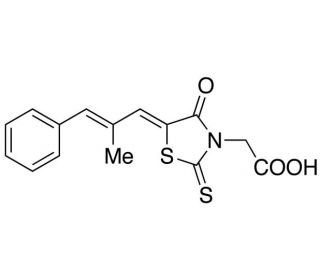

Epalrestat (CAS 82159-09-9)
See product citations (2)
QUICK LINKS
Epalrestat is a compound utilized in research focused on the inhibition of certain enzymes, specifically aldose reductase. In biological studies, it is used to understand the role of aldose reductase in the polyol pathway, a metabolic pathway that converts glucose to sorbitol. Researchers employ epalrestat to investigate the effects of aldose reductase inhibition on cellular processes related to osmotic stress and the accumulation of sorbitol, particularly in tissues where the polyol pathway is active. Additionally, epalrestat is involved in studies examining its impact on the biochemical mechanisms of complications arising from chronic conditions. It is also used to study the structure-activity relationship of aldose reductase inhibitors, providing insights into the design of more effective compounds. In material science and chemistry, epalrestat can be used to explore its interactions with other molecules and its stability under various experimental conditions.
Epalrestat (CAS 82159-09-9) References
- Epalrestat: an aldose reductase inhibitor for the treatment of diabetic neuropathy. | Ramirez, MA. and Borja, NL. 2008. Pharmacotherapy. 28: 646-55. PMID: 18447661
- Epalrestat-loaded silicone hydrogels as contact lenses to address diabetic-eye complications. | Alvarez-Rivera, F., et al. 2018. Eur J Pharm Biopharm. 122: 126-136. PMID: 29079419
- The aldose reductase inhibitor epalrestat exerts nephritic protection on diabetic nephropathy in db/db mice through metabolic modulation. | He, J., et al. 2019. Acta Pharmacol Sin. 40: 86-97. PMID: 29930278
- Epalrestat, an Aldose Reductase Inhibitor, Restores Erectile Function in Streptozocin-induced Diabetic Rats. | Yang, BB., et al. 2019. Int J Impot Res. 31: 97-104. PMID: 30214006
- Alpha lipoic acid combined with epalrestat: a therapeutic option for patients with diabetic peripheral neuropathy. | Wang, X., et al. 2018. Drug Des Devel Ther. 12: 2827-2840. PMID: 30233145
- The AKR1B1 inhibitor epalrestat suppresses the progression of cervical cancer. | Ji, J., et al. 2020. Mol Biol Rep. 47: 6091-6103. PMID: 32761301
- Current concepts in the management of diabetic polyneuropathy. | Ziegler, D., et al. 2021. J Diabetes Investig. 12: 464-475. PMID: 32918837
- Epalrestat suppresses cadmium-induced cytotoxicity through Nrf2 in endothelial cells. | Tatsunami, R., et al. 2021. Exp Ther Med. 21: 393. PMID: 33680115
- Epalrestat suppresses inflammatory response in lipopolysaccharide-stimulated RAW264.7 cells. | Sato, K., et al. 2021. Allergol Immunopathol (Madr). 49: 1-8. PMID: 34476915
- Sorbitol Is a Severity Biomarker for PMM2-CDG with Therapeutic Implications. | Ligezka, AN., et al. 2021. Ann Neurol. 90: 887-900. PMID: 34652821
- Pain Allaying Epalrestat-Loaded Lipid Nanoformulation for the Diabetic Neuropathic Pain Interventions: Design, Development, and Animal Study. | Vishwakarma, VK., et al. 2022. Curr Drug Metab. 23: 571-583. PMID: 35950248
- Moving toward a new horizon for the aldose reductase inhibitor epalrestat to treat drug-resistant cancer. | Bailly, C. 2022. Eur J Pharmacol. 931: 175191. PMID: 35964660
- Epalrestat. A review of its pharmacology, and therapeutic potential in late-onset complications of diabetes mellitus. | Steele, JW., et al. 1993. Drugs Aging. 3: 532-55. PMID: 8312678
Ordering Information
| Product Name | Catalog # | UNIT | Price | Qty | FAVORITES | |
Epalrestat, 10 mg | sc-218319 | 10 mg | $200.00 |