
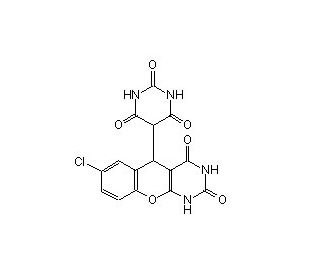

Molecular structure of EM20-25, CAS Number: 141266-44-6
EM20-25 (CAS 141266-44-6)
Alternate Names:
5-(6-Chloro-2,4-dioxo-1,3,4,10-tetrahydro-2H-9-oxa-1,3-diaza-anthracen-10-yl)-pyrimidine-2,4,6-trione
Application:
EM20-25 is a disruptor of Bcl-2/BAX interactions
CAS Number:
141266-44-6
Purity:
≥95%
Molecular Weight:
376.7
Molecular Formula:
C15H9CLN4O6
For Research Use Only. Not Intended for Diagnostic or Therapeutic Use.
* Refer to Certificate of Analysis for lot specific data.
QUICK LINKS
Ordering Information
Description
Technical Information
Safety Information
SDS & Certificate of Analysis
A cell-permeable pyrimidine-trione compound that sensitizes apoptosis-resistant, Bcl-2-overexpressing leukemic cells to cytotoxic drugs. It has shown to bind to Bcl-2, disrupt its interaction with Bax as well as activate caspase-9. It also induces PTP (permeability transition pore) opening in both isolated mitochondria and intact cells, without any effect on respiration.
EM20-25 (CAS 141266-44-6) References
- The mitochondrial effects of small organic ligands of BCL-2: sensitization of BCL-2-overexpressing cells to apoptosis by a pyrimidine-2,4,6-trione derivative. | Milanesi, E., et al. 2006. J Biol Chem. 281: 10066-72. PMID: 16481323
- The identity and regulation of the mitochondrial permeability transition pore: where the known meets the unknown. | Juhaszova, M., et al. 2008. Ann N Y Acad Sci. 1123: 197-212. PMID: 18375592
- Targeting the apoptotic pathway with BCL-2 inhibitors sensitizes primary chronic lymphocytic leukemia cells to vesicular stomatitis virus-induced oncolysis. | Tumilasci, VF., et al. 2008. J Virol. 82: 8487-99. PMID: 18579592
- Hyperbaric oxygen induces apoptosis via a mitochondrial mechanism. | Weber, SU., et al. 2009. Apoptosis. 14: 97-107. PMID: 19052874
- AKT/mTOR pathway activation and BCL-2 family proteins modulate the sensitivity of human small cell lung cancer cells to RAD001. | Marinov, M., et al. 2009. Clin Cancer Res. 15: 1277-87. PMID: 19228731
- Different forms of cell death induced by putative BCL2 inhibitors. | Vogler, M., et al. 2009. Cell Death Differ. 16: 1030-9. PMID: 19390557
- Activation of mitochondrial ERK protects cancer cells from death through inhibition of the permeability transition. | Rasola, A., et al. 2010. Proc Natl Acad Sci U S A. 107: 726-31. PMID: 20080742
- Use of human cancer cell lines mitochondria to explore the mechanisms of BH3 peptides and ABT-737-induced mitochondrial membrane permeabilization. | Buron, N., et al. 2010. PLoS One. 5: e9924. PMID: 20360986
- SERPINB3 protects from oxidative damage by chemotherapeutics through inhibition of mitochondrial respiratory complex I. | Ciscato, F., et al. 2014. Oncotarget. 5: 2418-27. PMID: 24810714
- Inhibition of succinate dehydrogenase by the mitochondrial chaperone TRAP1 has anti-oxidant and anti-apoptotic effects on tumor cells. | Guzzo, G., et al. 2014. Oncotarget. 5: 11897-908. PMID: 25564869
- HSP70 mediates survival in apoptotic cells-Boolean network prediction and experimental validation. | Vasaikar, SV., et al. 2015. Front Cell Neurosci. 9: 319. PMID: 26379495
- Inhibition of yeast-to-filamentous growth transitions in Candida albicans by a small molecule inducer of mammalian apoptosis. | Goffena, J., et al. 2018. Yeast. 35: 291-298. PMID: 29048745
- Lysosomal K+ channel TMEM175 promotes apoptosis and aggravates symptoms of Parkinson's disease. | Qu, L., et al. 2022. EMBO Rep. 23: e53234. PMID: 35913019
Inhibitor of:
Bcl-2, and caspase-8.Activator of:
caspase-9.Ordering Information
| Product Name | Catalog # | UNIT | Price | Qty | FAVORITES | |
EM20-25, 10 mg | sc-221288 | 10 mg | $155.00 |