
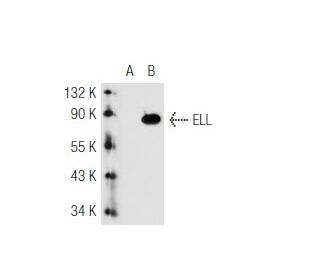
ELL Antibody (2316C1a): sc-81264
- ELL Antibody (2316C1a) is a mouse monoclonal IgG1 provided at 100 µg/ml
- raised against a recombinant protein corresponding to an internal region of ELL of human origin
- recommended for detection of ELL of human and, to a lesser extent, mouse, rat origin by WB and IP
- At present, we have not yet completed the identification of the preferred secondary detection reagent(s) for ELL Antibody (2316C1a). This work is in progress.

QUICK LINKS
ELL Antibody (2316C1a) is a mouse monoclonal IgG1 antibody that detects ELL in human, mouse, and rat samples through applications such as western blotting (WB) and immunoprecipitation (IP). ELL, or 11-19 lysine-rich leukemia protein, plays a crucial role in the transcription cycle by acting as an elongation factor for RNA polymerase II, thereby enhancing the rate of transcription and suppressing transient pausing during elongation. This function is vital for the regulation of gene expression, which in turn influences cellular proliferation and differentiation. ELL is predominantly expressed in peripheral blood leukocytes, skeletal muscle, placenta, and testis, while exhibiting lower levels in tissues such as the spleen, thymus, heart, brain, lung, kidney, liver, and ovary. The gene encoding human ELL is located on chromosome 19p13.1 and is implicated in acute myeloid leukemia due to its translocation with the MLL gene on chromosome 11q23, a gene essential for embryonal and hematopoietic development. Anti-ELL antibody (2316C1a) is an invaluable tool for researchers studying the mechanisms of transcription regulation and its implications in various diseases, including cancer.
Alexa Fluor® is a trademark of Molecular Probes Inc., OR., USA
LI-COR® and Odyssey® are registered trademarks of LI-COR Biosciences
ELL Antibody (2316C1a) References:
- Physical interaction and functional antagonism between the RNA polymerase II elongation factor ELL and p53. | Shinobu, N., et al. 1999. J Biol Chem. 274: 17003-10. PMID: 10358050
- A carboxy-terminal domain of ELL is required and sufficient for immortalization of myeloid progenitors by MLL-ELL. | DiMartino, JF., et al. 2000. Blood. 96: 3887-93. PMID: 11090074
- Functional analysis of the leukemia protein ELL: evidence for a role in the regulation of cell growth and survival. | Johnstone, RW., et al. 2001. Mol Cell Biol. 21: 1672-81. PMID: 11238904
- ELL and EAF1 are Cajal body components that are disrupted in MLL-ELL leukemia. | Polak, PE., et al. 2003. Mol Biol Cell. 14: 1517-28. PMID: 12686606
- Acute myelogenous leukemia cells with the MLL-ELL translocation convert morphologically and functionally into adherent myofibroblasts. | Tashiro, H., et al. 2010. Biochem Biophys Res Commun. 391: 592-7. PMID: 19932689
- The Tax oncogene enhances ELL incorporation into p300 and P-TEFb containing protein complexes to activate transcription. | Fufa, TD., et al. 2015. Biochem Biophys Res Commun. 465: 5-11. PMID: 26188510
- ELL targets c-Myc for proteasomal degradation and suppresses tumour growth. | Chen, Y., et al. 2016. Nat Commun. 7: 11057. PMID: 27009366
- Rare KMT2A-ELL and Novel ZNF56-KMT2A Fusion Genes in Pediatric T-cell Acute Lymphoblastic Leukemia. | Panagopoulos, I., et al. 2021. Cancer Genomics Proteomics. 18: 121-131. PMID: 33608309
- Stratification and therapeutic potential of ELL in cytogenetic normal acute myeloid leukemia. | Zha, J., et al. 2023. Gene. 856: 147110. PMID: 36543308
- Rare case of pediatric trilineal mixed-phenotype acute leukemia with t(11;19)(q23.3;p13)/KMT2A::ELL. | Demina, I., et al. 2023. Leuk Res. 125: 107018. PMID: 36640593
Ordering Information
| Product Name | Catalog # | UNIT | Price | Qty | FAVORITES | |
ELL Antibody (2316C1a) | sc-81264 | 100 µg/ml | $339.00 |