
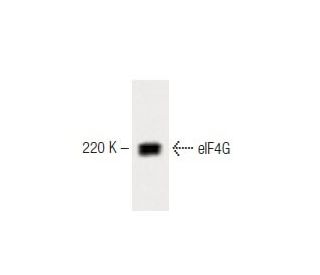


eIF4G Antibody (40): sc-136142
- eIF4G Antibody (40) is a mouse monoclonal IgG1, cited in 1 publications, provided at 50 µg/0.5 ml
- raised against amino acids 1217-1386 of eIF4G of human origin
- recommended for detection of eIF4G of human and canine origin by WB, IP and IF; not recommended for IP
- See eIF4G (A-10): sc-133155 for eIF4G antibody conjugates, including AC, HRP, FITC, PE, Alexa Fluor® 488, 594, 647, 680 and 790.
- At present, we have not yet completed the identification of the preferred secondary detection reagent(s) for eIF4G Antibody (40). This work is in progress.

eIF4G Antibody (40) is a mouse monoclonal IgG1 antibody that detects eIF4G in human and canine samples through applications such as western blotting (WB), immunoprecipitation (IP), and immunofluorescence (IF). eIF4G is a crucial component of the eukaryotic initiation complex, playing a vital role in the regulation of protein synthesis by facilitating the binding of ribosomes to mRNA. eIF4G acts as a scaffold, linking the mRNA cap-binding protein eIF4E and the ATP-dependent RNA helicase eIF4A, thereby promoting the unwinding of mRNA secondary structures and ensuring efficient translation initiation. Proper functioning of eIF4G is essential for cellular growth and proliferation, as eIF4G directly influences the rate of protein synthesis, which is critical for various cellular processes, including cell division and response to stress. Dysregulation of eIF4G has been implicated in several diseases, including cancer, making eIF4G an important target for research and therapeutic interventions. Anti-eIF4G antibody (40) provides a reliable tool for studying the dynamics of protein synthesis and the role of eIF4G in various biological contexts.
Alexa Fluor® is a trademark of Molecular Probes Inc., OR., USA
LI-COR® and Odyssey® are registered trademarks of LI-COR Biosciences
eIF4G Antibody (40) References:
- RGG-motif self-association regulates eIF4G-binding translation repressor protein Scd6. | Poornima, G., et al. 2019. RNA Biol. 16: 1215-1227. PMID: 31157589
- Autism-Misregulated eIF4G Microexons Control Synaptic Translation and Higher Order Cognitive Functions. | Gonatopoulos-Pournatzis, T., et al. 2020. Mol Cell. 77: 1176-1192.e16. PMID: 31999954
- eIF4G has intrinsic G-quadruplex binding activity that is required for tiRNA function. | Lyons, SM., et al. 2020. Nucleic Acids Res. 48: 6223-6233. PMID: 32374873
- HSP70-eIF4G Interaction Promotes Protein Synthesis and Cell Proliferation in Hepatocellular Carcinoma. | Wang, M., et al. 2020. Cancers (Basel). 12: PMID: 32823513
- eIF4G-driven translation initiation of downstream ORFs in mammalian cells. | Nobuta, R., et al. 2020. Nucleic Acids Res. 48: 10441-10455. PMID: 32941651
- eIF4E-eIF4G complex inhibition synergistically enhances the effect of sorafenib in hepatocellular carcinoma. | Fang, C., et al. 2021. Anticancer Drugs. 32: 822-828. PMID: 33783376
- Genome Editing of Rice eIF4G Loci Confers Partial Resistance to Rice Black-Streaked Dwarf Virus. | Wang, W., et al. 2021. Viruses. 13: PMID: 34696530
- Ferritin Iron Responsive Elements (IREs) mRNA Interacts with eIF4G and Activates In Vitro Translation. | Khan, MA. 2022. Front Biosci (Elite Ed). 14: 17. PMID: 36137989
- Dissecting the roles of EIF4G homologs reveals DAP5 as a modifier of CGG repeat-associated toxicity in a Drosophila model of FXTAS. | Malik, I., et al. 2023. Neurobiol Dis. 184: 106212. PMID: 37352983
- eIF4G as a switch for heat shock mRNA translation. | Liu, Y. and Yang, P. 2024. Mol Cell. 84: 1633-1634. PMID: 38701739
Ordering Information
| Product Name | Catalog # | UNIT | Price | Qty | FAVORITES | |
eIF4G Antibody (40) | sc-136142 | 50 µg/0.5 ml | $322.00 |