
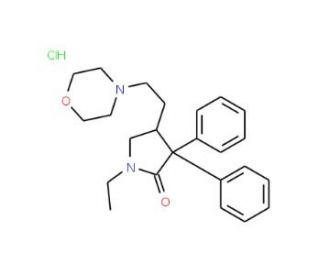

Molecular structure of Doxapram hydrochloride, CAS Number: 113-07-5
Doxapram hydrochloride (CAS 113-07-5)
Alternate Names:
Dopram; Stimulexin
CAS Number:
113-07-5
Molecular Weight:
414.97
Molecular Formula:
C24H31ClN2O2
Supplemental Information:
This is classified as a Dangerous Good for transport and may be subject to additional shipping charges.
For Research Use Only. Not Intended for Diagnostic or Therapeutic Use.
* Refer to Certificate of Analysis for lot specific data.
QUICK LINKS
Ordering Information
Description
Technical Information
Safety Information
SDS & Certificate of Analysis
Doxapram hydrochloride is a compound utilized primarily in the study of respiratory and neurological systems within a research context. It activates chemoreceptors in the carotid body, which may be useful for investigating the regulation of breathing. In neurobiology, Doxapram hydrochloride is of interest for its stimulatory effects on the central nervous system, particularly in the context of neural response and reflex pathways under varying levels of oxygen. This compound also plays a role in research on the mechanisms of respiratory drive and its modulation by endogenous and exogenous factors. In addition, Doxapram hydrochloride is employed to explore the regulation of autonomic responses.
Doxapram hydrochloride (CAS 113-07-5) References
- Visual compatibility of doxapram hydrochloride with drugs commonly administered via a Y-site in the intensive care nursery. | Bell, MS. and Nolt, DH. 2003. Am J Health Syst Pharm. 60: 193-4. PMID: 12561666
- Determination of azasetron hydrochloride in rabbit plasma by liquid chromatography tandem mass spectrometry and its application. | Lin, G., et al. 2011. Biomed Chromatogr. 25: 1107-11. PMID: 21204117
- Effects of obesity on lung function and airway reactivity in healthy dogs. | Manens, J., et al. 2012. Vet J. 193: 217-21. PMID: 22099184
- Doxapram hydrochloride aggravates adrenaline-induced arrhythmias accompanied by bidirectional ventricular tachycardia. | Oikawa, S., et al. 2014. ISRN Cardiol. 2014: 212045. PMID: 24527224
- Doxapram hydrochloride and the colostral transfer of immunity to lambs. | Boyd, JW. and Notter, DR. 1989. Vet Rec. 124: 464-5. PMID: 2728300
- Doxapram: cardiopulmonary effects in the horse. | Wernette, KM., et al. 1986. Am J Vet Res. 47: 1360-2. PMID: 3729140
- Hepatic necrosis with doxapram hydrochloride. | Fancourt, GJ., et al. 1985. Postgrad Med J. 61: 833-5. PMID: 4059148
- Arousal time following intravenous anesthetic agents, methohexital and thiopental: effect of doxapram hydrochloride. | Po, BT., et al. 1968. Anesth Analg. 47: 446-51. PMID: 4385392
- The use of doxapram hydrochloride with intravenous anesthetics in horses. I. | Short, CE., et al. 1970. Vet Med Small Anim Clin. 65: 157-60. PMID: 4392135
- An evaluation of doxapram hydrochloride to control respiration in dogs during and after inhalation anesthesia. | Short, CE., et al. 1970. Vet Med Small Anim Clin. 65: 787-90. PMID: 4393696
- Postanesthetic administration of doxapram hydrochloride and/or oxygen at an altitude of 1 mile. | Virtue, RW., et al. 1972. Anesth Analg. 51: 1-5. PMID: 4399968
- Clinical effects of respiratory stimulation with doxapram hydrochloride during neuroleptanalgesia for bronchoscopy. | Arnold, FS., et al. 1973. Anesth Analg. 52: 643-50. PMID: 4736863
- Routine use of doxapram hydrochloride in neonatal pups delivered by cesarean section. | Holladay, JR. 1971. Vet Med Small Anim Clin. 66: 28. PMID: 5212184
- Doxapram reversal of respiratory failure in a patient refusing assisted ventilation. | McNamara, RM. and Euerle, BD. 1994. Ann Emerg Med. 24: 751-4. PMID: 8092607
- I.V. doxapram hydrochloride and pulmonary complications after lower abdominal surgery. | Downing, JW., et al. 1977. Br J Anaesth. 49: 473-7. PMID: 861115
Ordering Information
| Product Name | Catalog # | UNIT | Price | Qty | FAVORITES | |
Doxapram hydrochloride, 5 mg | sc-279008 | 5 mg | $150.00 |